
Join Our JEE Preparation Group
Prep with like-minded aspirants; Get access to free daily tests and study material.
Sign in
Please select an account to continue using cracku.in
↓ →
Join Our JEE Preparation Group
Prep with like-minded aspirants; Get access to free daily tests and study material.
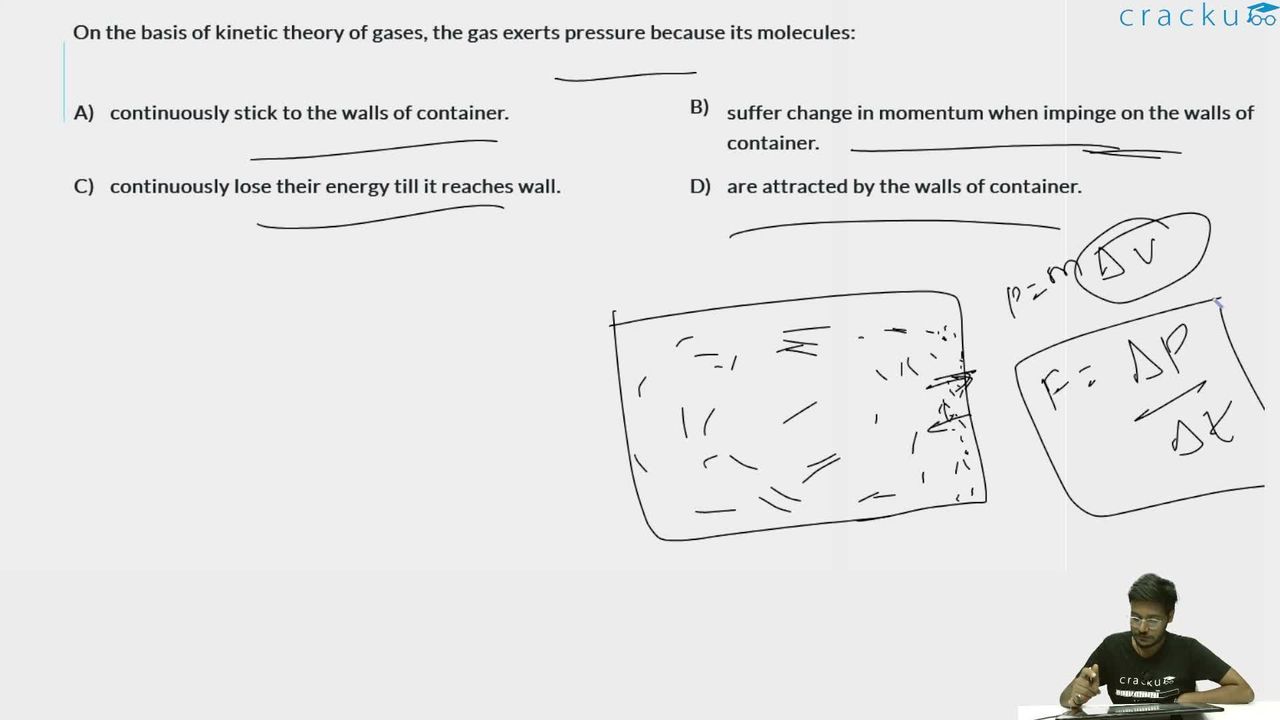
On the basis of kinetic theory of gases, the gas exerts pressure because its molecules:
According to the kinetic theory of gases, gas molecules are in constant random motion and frequently collide with the walls of the container.
When a gas molecule hits the wall, it bounces back. During this collision, the molecule's momentum changes direction. By Newton's second law, the rate of change of momentum equals the force exerted. Since millions of molecules strike the walls every second, the cumulative effect of these momentum changes produces a steady, measurable force on the walls.
The pressure exerted by the gas is this total force per unit area of the container wall. The molecules do not stick to the walls, nor are they attracted by the walls, nor do they lose energy before reaching the walls (collisions are assumed elastic in the kinetic theory model).
Therefore, the gas exerts pressure because its molecules suffer a change in momentum when they impinge on the walls of the container.
The correct answer is that the molecules suffer change in momentum when impinge on the walls of container.
Was this solution helpful?
Click on the Email ☝️ to Watch the Video Solution
Create a FREE account and get:
_1.webp)

Educational materials for JEE preparation

Ask our AI anything

AI can make mistakes. Please verify important information.
AI can make mistakes. Please verify important information.


