
Join Our JEE Preparation Group
Prep with like-minded aspirants; Get access to free daily tests and study material.
Sign in
Please select an account to continue using cracku.in
↓ →
Join Our JEE Preparation Group
Prep with like-minded aspirants; Get access to free daily tests and study material.
The angle of elevation of a cloud $$C$$ from a point $$P$$, 200 m above a still lake is 30°. If the angle of depression of the image of $$C$$ in the lake from the point $$P$$ is 60°, then $$PC$$ (in m) is equal to
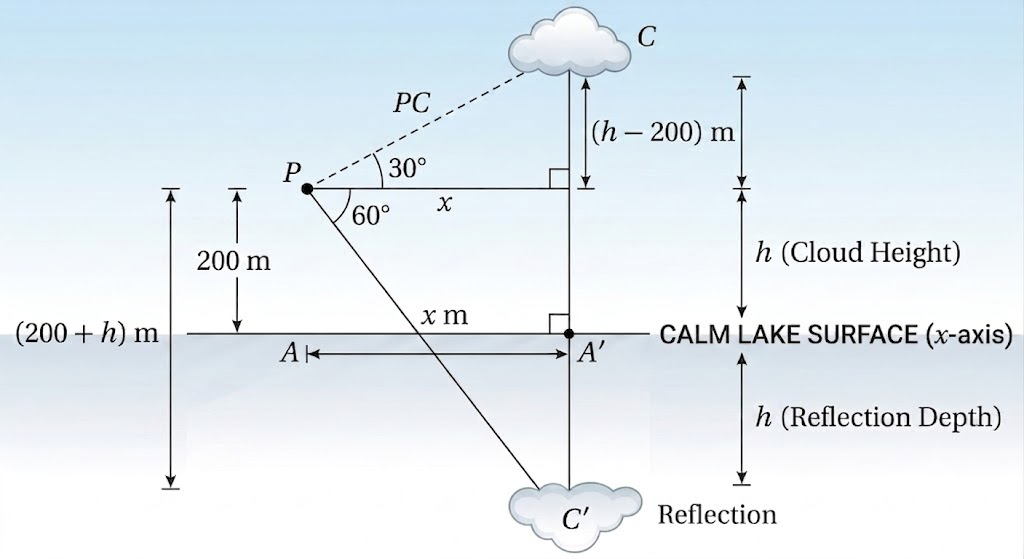
Let the still surface of the lake be a horizontal plane. Choose a point $$A$$ on this surface such that the given point $$P$$ lies vertically above $$A$$. We are told that $$P$$ is 200 m above the lake, so $$PA = 200\text{ m}$$.
Let the cloud be $$C$$ and its image in the lake be $$C'$$. Because an image in a perfectly still lake is formed by reflection in the water surface, $$C$$ and $$C'$$ are on the same vertical line through $$A'$$, with $$A'$$ exactly midway between them. If we denote the height of the cloud above the lake by $$h$$ metres, then
$$A'C = h,\qquad A'C' = h,\qquad \text{and}\qquad C'$$ is $$h$$ metres below the water surface.
Put the horizontal distance of both $$C$$ and $$C'$$ from the foot $$A$$ as $$x$$ metres. Thus the coordinates (taking the lake surface as the $$x$$-axis and up as positive $$y$$) can be visualised as
$$A(0,0),\; P(0,200),\; C(x,h),\; C'(x,-h).$$
The angle of elevation of $$C$$ from $$P$$ is 30°. By the definition of tangent in a right triangle,
$$\tan 30^{\circ} \;=\; \frac{\text{opposite side}}{\text{adjacent side}} \;=\; \frac{(h-200)}{x}.$$
Since $$\tan 30^{\circ} = \frac{1}{\sqrt{3}}$$, we get
$$\frac{1}{\sqrt{3}} = \frac{h-200}{x} \;\;\Longrightarrow\;\; x = \sqrt{3}\,(h-200). \quad (1)$$
Next, the angle of depression of the image $$C'$$ from $$P$$ is 60°. The angle of depression equals the angle the line of sight makes below the horizontal. Using the same tangent definition, we have
$$\tan 60^{\circ} = \frac{\text{vertical drop from }P\text{ to }C'}{\text{horizontal distance }x} = \frac{200+h}{x}.$$
Because $$\tan 60^{\circ} = \sqrt{3}$$, this yields
$$\sqrt{3} = \frac{200+h}{x} \;\;\Longrightarrow\;\; x = \frac{200+h}{\sqrt{3}}. \quad (2)$$
Both equations (1) and (2) represent the same value of $$x$$, so we equate them:
$$\sqrt{3}(h-200) = \frac{200+h}{\sqrt{3}}.$$
Multiplying both sides by $$\sqrt{3}$$ to clear the denominator,
$$3(h-200) = 200 + h.$$
Expanding and rearranging step by step,
$$3h - 600 = 200 + h$$
$$3h - h = 200 + 600$$
$$2h = 800$$
$$h = 400.$$
So the cloud is $$400\text{ m}$$ above the lake.
The vertical separation between $$P$$ and $$C$$ is therefore
$$\text{vertical difference} = h - 200 = 400 - 200 = 200\text{ m}.$$
Substituting $$h = 400$$ into equation (1) (or equation (2)) to find $$x$$,
$$x = \sqrt{3}(h-200) = \sqrt{3}\times 200 = 200\sqrt{3}\text{ m}.$$
Now we know both the horizontal and vertical components of the line segment $$PC$$. Using the Pythagoras theorem, which states $$\text{hypotenuse}^2 = \text{base}^2 + \text{perpendicular}^2,$$ we have
$$PC = \sqrt{(200)^2 + (200\sqrt{3})^2} = \sqrt{40000 + 120000} = \sqrt{160000} = 400\text{ m}.$$
Hence, the correct answer is Option C.
Was this solution helpful?
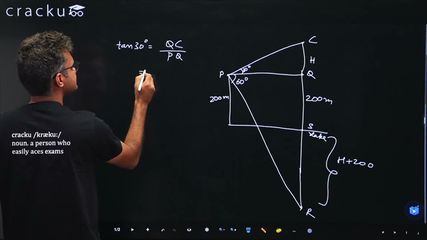
Click on the Email ☝️ to Watch the Video Solution
Create a FREE account and get:
_1.webp)

Educational materials for JEE preparation

Ask our AI anything

AI can make mistakes. Please verify important information.
AI can make mistakes. Please verify important information.


