
Join Our JEE Preparation Group
Prep with like-minded aspirants; Get access to free daily tests and study material.
Sign in
Please select an account to continue using cracku.in
↓ →
Join Our JEE Preparation Group
Prep with like-minded aspirants; Get access to free daily tests and study material.
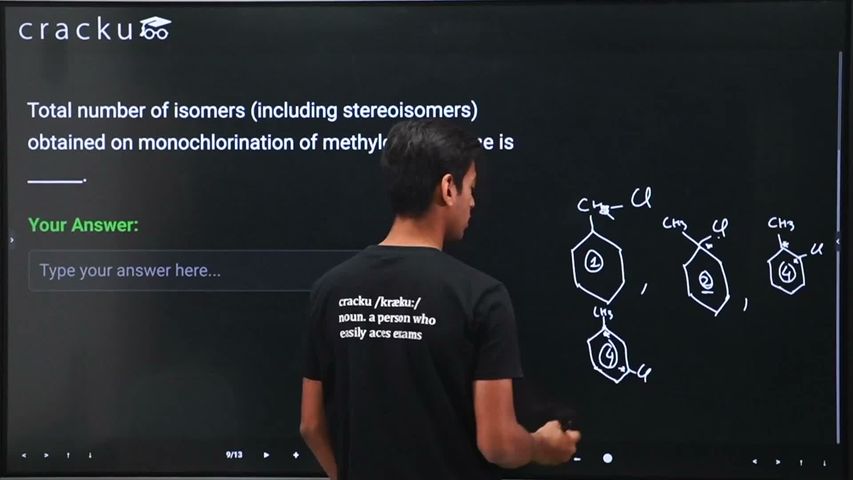
Total number of isomers (including stereoisomers) obtained on monochlorination of methylcyclohexane is ______.
Correct Answer: 12
We need to find the total number of isomers (including stereoisomers) obtained on monochlorination of methylcyclohexane.
Methylcyclohexane has a cyclohexane ring with a methyl group at C1. The distinct hydrogen positions are:
- $$CH_3$$ group (methyl hydrogens): 3 equivalent H atoms
- C1 (tertiary hydrogen): 1 H atom
- C2 and C6 (equivalent by symmetry): each has 2 H atoms
- C3 and C5 (equivalent by symmetry): each has 2 H atoms
- C4: 2 H atoms
(i) Chlorination at the methyl group:
Replacing one H on $$CH_3$$ gives a $$CH_2Cl$$ group attached to the ring.
No chiral center is created. This gives 1 product.
(ii) Chlorination at C1 (tertiary position):
Cl replaces the tertiary H. C1 now bears $$CH_3$$, Cl, and two ring carbons. The molecule has a plane of symmetry through C1-C4, so no chirality.
This gives 1 product.
(iii) Chlorination at C2 (or C6):
This produces 1-methyl-2-chlorocyclohexane. Both C1 and C2 become stereocenters.
- cis-1-methyl-2-chlorocyclohexane: The two substituents are on the same side of the ring. C1 and C2 are both chiral centers with no internal plane of symmetry, giving a pair of enantiomers = 2 stereoisomers.
- trans-1-methyl-2-chlorocyclohexane: The two substituents are on opposite sides. Again, C1 and C2 are chiral centers giving a pair of enantiomers = 2 stereoisomers.
Subtotal from C2/C6 position: 4 stereoisomers.
(iv) Chlorination at C3 (or C5):
This produces 1-methyl-3-chlorocyclohexane. Both C1 and C3 are stereocenters.
- cis-1-methyl-3-chlorocyclohexane: Enantiomeric pair = 2 stereoisomers.
- trans-1-methyl-3-chlorocyclohexane: Enantiomeric pair = 2 stereoisomers.
Subtotal from C3/C5 position: 4 stereoisomers.
(v) Chlorination at C4:
This produces 1-methyl-4-chlorocyclohexane. The molecule has a plane of symmetry through C1 and C4.
- cis-1-methyl-4-chlorocyclohexane: Has a plane of symmetry, so it is achiral = 1 stereoisomer.
- trans-1-methyl-4-chlorocyclohexane: Also has a plane of symmetry, so it is achiral = 1 stereoisomer.
Subtotal from C4 position: 2 stereoisomers.
| Position | Number of isomers |
|---|---|
| Methyl group | 1 |
| C1 | 1 |
| C2/C6 | 4 |
| C3/C5 | 4 |
| C4 | 2 |
| Total | 12 |
Therefore, the total number of isomers (including stereoisomers) is $$\boxed{12}$$.
Was this solution helpful?
Click on the Email ☝️ to Watch the Video Solution
Create a FREE account and get:
_1.webp)

Educational materials for JEE preparation

Ask our AI anything

AI can make mistakes. Please verify important information.
AI can make mistakes. Please verify important information.
