
Join Our JEE Preparation Group
Prep with like-minded aspirants; Get access to free daily tests and study material.
Sign in
Please select an account to continue using cracku.in
↓ →
Join Our JEE Preparation Group
Prep with like-minded aspirants; Get access to free daily tests and study material.
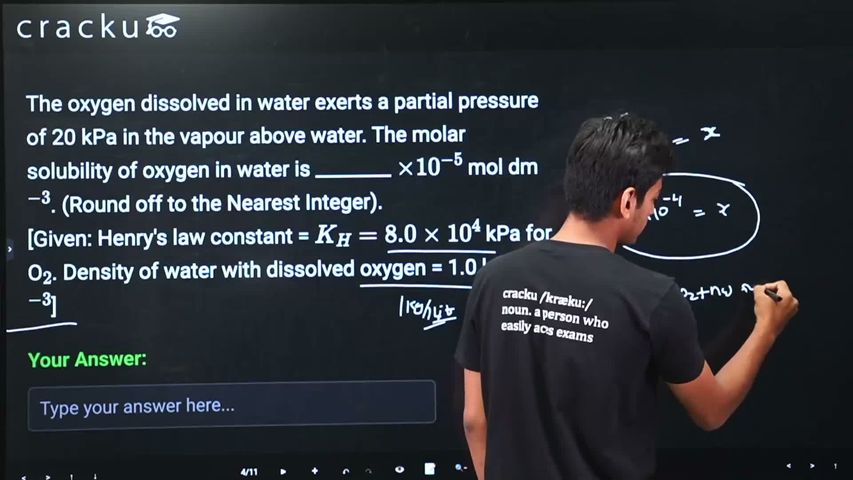
The oxygen dissolved in water exerts a partial pressure of 20 kPa in the vapour above water. The molar solubility of oxygen in water is ________ $$\times 10^{-5}$$ mol dm$$^{-3}$$. (Round off to the Nearest Integer).
[Given: Henry's law constant = $$K_H = 8.0 \times 10^4$$ kPa for O$$_2$$. Density of water with dissolved oxygen = 1.0 kg dm$$^{-3}$$]
Correct Answer: 1389
By Henry's law, the mole fraction of a dissolved gas is related to its partial pressure by $$p = K_H \times x$$, where $$K_H$$ is Henry's law constant and $$x$$ is the mole fraction. Rearranging: $$x = \frac{p}{K_H} = \frac{20}{8.0 \times 10^4} = 2.5 \times 10^{-4}$$.
Since the mole fraction of dissolved oxygen is very small, practically all the moles in solution are water. Taking 1 dm$$^3$$ of solution with density 1.0 kg dm$$^{-3}$$, the mass of water is approximately 1000 g, giving $$\frac{1000}{18} \approx 55.56$$ mol of water.
The moles of dissolved $$O_2$$ per dm$$^3$$ is $$x \times n_{water} = 2.5 \times 10^{-4} \times 55.56 = 0.01389$$ mol = $$1389 \times 10^{-5}$$ mol. The molar solubility is therefore $$1389 \times 10^{-5}$$ mol dm$$^{-3}$$, and the answer is 1389.
Was this solution helpful?
Click on the Email ☝️ to Watch the Video Solution
Create a FREE account and get:
_1.webp)

Educational materials for JEE preparation

Ask our AI anything

AI can make mistakes. Please verify important information.
AI can make mistakes. Please verify important information.
