
Join Our JEE Preparation Group
Prep with like-minded aspirants; Get access to free daily tests and study material.
Sign in
Please select an account to continue using cracku.in
↓ →
Join Our JEE Preparation Group
Prep with like-minded aspirants; Get access to free daily tests and study material.
Let $$X = \{x \in N : 1 \le x \le 17\}$$ and $$Y = \{ax + b : x \in X \text{ and } a, b \in R, a > 0\}$$. If mean and variance of elements of Y are 17 and 216 respectively then $$a + b$$ is equal to:
We have the finite set $$X=\{1,2,3,\dots ,17\}$$. Its size is clearly $$|X|=17$$, so whenever we speak of the “mean’’ and “variance’’ of the elements of $$X$$ we are using the uniform distribution in which each element appears with probability $$\tfrac1{17}$$.
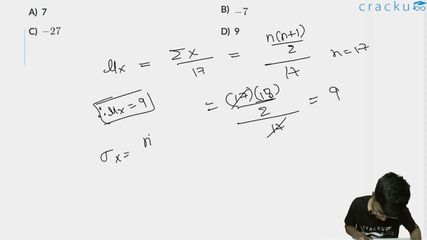
First we calculate the mean of the elements of $$X$$. The sum of the first $$n$$ natural numbers is given by the well-known formula $$\sum_{x=1}^{n} x=\frac{n(n+1)}2.$$ Substituting $$n=17$$ we obtain $$\sum_{x=1}^{17} x=\frac{17\cdot18}2=153.$$ Hence the mean of $$X$$ is $$\mu_X=\frac1{17}\sum_{x=1}^{17}x=\frac{153}{17}=9.$$
Next we need the variance of the numbers $$1,2,\dots ,17$$. By definition, $$\sigma_X^{2}=\frac1{17}\sum_{x=1}^{17}(x-\mu_X)^2.$$ A convenient way to compute this is to use the identity $$\sigma_X^{2}=\frac1{17}\sum_{x=1}^{17}x^{2}-\mu_X^{2}.$$ The sum of squares formula $$\sum_{x=1}^{n}x^{2}=\frac{n(n+1)(2n+1)}6$$ gives, for $$n=17$$, $$\sum_{x=1}^{17}x^{2}=\frac{17\cdot18\cdot35}6.$$ Evaluating step by step, we see $$17\cdot18=306,\qquad 306\cdot35=10\,710,$$ and finally $$\frac{10\,710}{6}=1\,785.$$ Therefore $$\frac1{17}\sum_{x=1}^{17}x^{2}=\frac{1\,785}{17}=105.$$ Now subtracting the square of the mean, $$\sigma_X^{2}=105-9^{2}=105-81=24.$$
We are told that every element of $$Y$$ is obtained from some element of $$X$$ via the linear transformation $$Y=aX+b,$$ where $$a,b\in\mathbb{R}$$ with $$a>0$$. For any random variable, a linear change of scale and origin obeys the following standard formulas:
• Mean transformation: $$\mu_Y=a\mu_X+b.$$ • Variance transformation: $$\sigma_Y^{2}=a^{2}\sigma_X^{2}.$$
The problem states that the mean and variance of the set $$Y$$ are $$17$$ and $$216$$ respectively. Writing these facts with the above formulas we get the two equations $$a\mu_X+b=17,\qquad a^{2}\sigma_X^{2}=216.$$
Since we have already found $$\mu_X=9$$ and $$\sigma_X^{2}=24$$, we substitute:
From the mean condition: $$a\cdot9+b=17\quad\Longrightarrow\quad 9a+b=17. \quad -(1)$$
From the variance condition: $$a^{2}\cdot24=216\quad\Longrightarrow\quad a^{2}=\frac{216}{24}=9\quad\Longrightarrow\quad a=\pm3.$$ But the question explicitly requires $$a>0$$, therefore $$a=3.$$
Putting $$a=3$$ into equation (1): $$9(3)+b=17\quad\Longrightarrow\quad 27+b=17\quad\Longrightarrow\quad b=17-27=-10.$$
Finally, the quantity we are asked for is $$a+b=3+(-10)=-7.$$
Hence, the correct answer is Option B.
Click on the Email ☝️ to Watch the Video Solution
Create a FREE account and get:
_1.webp)

Educational materials for JEE preparation

Ask our AI anything

AI can make mistakes. Please verify important information.
AI can make mistakes. Please verify important information.


