
Join Our JEE Preparation Group
Prep with like-minded aspirants; Get access to free daily tests and study material.
Sign in
Please select an account to continue using cracku.in
↓ →
Join Our JEE Preparation Group
Prep with like-minded aspirants; Get access to free daily tests and study material.
Amongst $$FeCl_3 \cdot 3H_2O$$, $$K_3[Fe(CN)_6]$$ and $$[Co(NH_3)_6]Cl_3$$, the spin-only magnetic moment value of the inner-orbital complex that absorbs light at shortest wavelength is ______ B.M. [nearest integer]
Correct Answer: 2
We need to identify the inner-orbital complex that absorbs light at the shortest wavelength, then find its spin-only magnetic moment.
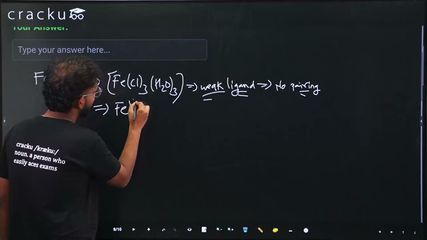
$$FeCl_3 \cdot 3H_2O$$: This can be written as $$[Fe(H_2O)_3Cl_3]$$. Water and chloride are weak field ligands, so $$Fe^{3+}$$ ($$d^5$$) uses outer orbitals ($$sp^3d^2$$ hybridization). This is an outer orbital complex.
$$K_3[Fe(CN)_6]$$: Here $$Fe^{3+}$$ ($$d^5$$) is coordinated with $$CN^-$$, a strong field ligand. The 5 electrons pair up as much as possible: $$t_{2g}^5 e_g^0$$ (2 paired + 1 unpaired). The complex uses inner $$d$$ orbitals ($$d^2sp^3$$ hybridization). This is an inner orbital complex.
$$[Co(NH_3)_6]Cl_3$$: Here $$Co^{3+}$$ ($$d^6$$) is coordinated with $$NH_3$$, a strong field ligand. All 6 electrons pair up in $$t_{2g}$$: $$t_{2g}^6 e_g^0$$ (0 unpaired). The complex uses inner $$d$$ orbitals ($$d^2sp^3$$). This is an inner orbital complex.
Shorter wavelength means higher energy, which corresponds to a larger crystal field splitting energy ($$\Delta$$). Since $$CN^-$$ is a stronger field ligand than $$NH_3$$ in the spectrochemical series, $$K_3[Fe(CN)_6]$$ has a larger $$\Delta$$ and absorbs light at the shortest wavelength.
$$Fe^{3+}$$: $$d^5$$ configuration with strong field $$CN^-$$ ligand.
Electron arrangement: $$t_{2g}^5 e_g^0$$ — the five electrons fill as: $$\uparrow\downarrow\ \uparrow\downarrow\ \uparrow$$ giving 1 unpaired electron.
$$\mu = \sqrt{n(n+2)} = \sqrt{1(1+2)} = \sqrt{3} = 1.73 \text{ B.M.}$$
Rounding to the nearest integer: $$\mu \approx 2$$ B.M.
The spin-only magnetic moment is 2 B.M.
Was this solution helpful?
Click on the Email ☝️ to Watch the Video Solution
Create a FREE account and get:
_1.webp)

Educational materials for JEE preparation

Ask our AI anything

AI can make mistakes. Please verify important information.
AI can make mistakes. Please verify important information.


