
Join Our JEE Preparation Group
Prep with like-minded aspirants; Get access to free daily tests and study material.
Sign in
Please select an account to continue using cracku.in
↓ →
Join Our JEE Preparation Group
Prep with like-minded aspirants; Get access to free daily tests and study material.
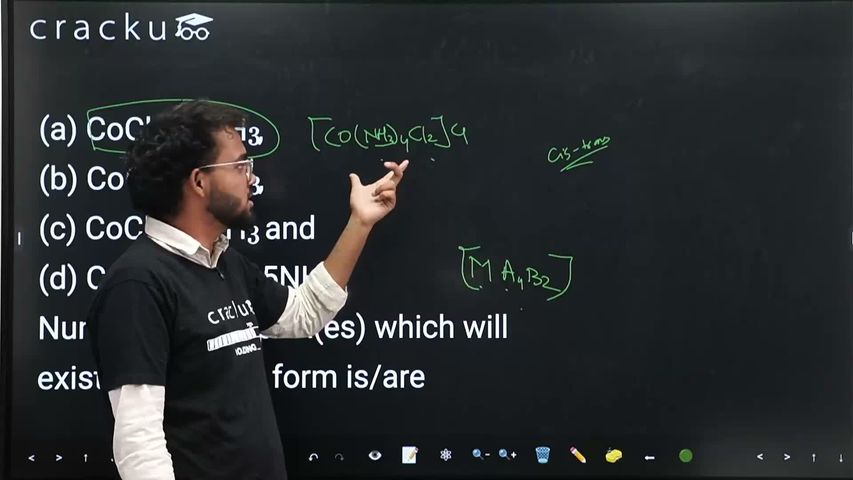
(a) CoCl$$_3$$ · 4NH$$_3$$,
(b) CoCl$$_3$$ · 5NH$$_3$$,
(c) CoCl$$_3$$ · 6NH$$_3$$ and
(d) CoCl(NO$$_3$$)$$_2$$ · 5NH$$_3$$
Number of complex(es) which will exist in cis-trans form is/are
Correct Answer: 1
We need to identify the coordination compounds that can exhibit cis-trans (geometrical) isomerism.
Compound (a): CoCl$$_3$$ · 4NH$$_3$$
Using Werner's theory, the complex is $$[\text{Co}(\text{NH}_3)_4\text{Cl}_2]\text{Cl}$$.
This is of the type $$[\text{MA}_4\text{B}_2]$$ in an octahedral geometry. In this arrangement, the two Cl ligands can be adjacent (cis) or opposite (trans).
Therefore, this compound exhibits cis-trans isomerism.
Compound (b): CoCl$$_3$$ · 5NH$$_3$$
The complex is $$[\text{Co}(\text{NH}_3)_5\text{Cl}]\text{Cl}_2$$.
This is of the type $$[\text{MA}_5\text{B}]$$, which has only one possible arrangement in octahedral geometry. No cis-trans isomerism is possible.
Compound (c): CoCl$$_3$$ · 6NH$$_3$$
The complex is $$[\text{Co}(\text{NH}_3)_6]\text{Cl}_3$$.
This is of the type $$[\text{MA}_6]$$, with all identical ligands. No geometrical isomerism is possible.
Compound (d): CoCl(NO$$_3$$)$$_2$$ · 5NH$$_3$$
The complex is $$[\text{Co}(\text{NH}_3)_5(\text{NO}_3)](\text{NO}_3)\text{Cl}$$.
This is of the type $$[\text{MA}_5\text{B}]$$, which does not show cis-trans isomerism.
Only compound (a) exhibits cis-trans isomerism.
Hence, the number of complexes existing in cis-trans form = $$\boxed{1}$$
Was this solution helpful?
Click on the Email ☝️ to Watch the Video Solution
Create a FREE account and get:
_1.webp)

Educational materials for JEE preparation

Ask our AI anything

AI can make mistakes. Please verify important information.
AI can make mistakes. Please verify important information.
