
Join Our JEE Preparation Group
Prep with like-minded aspirants; Get access to free daily tests and study material.
Sign in
Please select an account to continue using cracku.in
↓ →
Join Our JEE Preparation Group
Prep with like-minded aspirants; Get access to free daily tests and study material.
The set of all possible values of $$\theta$$ in the interval $$(0, \pi)$$ for which the points $$(1, 2)$$ and $$(\sin\theta, \cos\theta)$$ lie on the same side of the line $$x + y = 1$$ is:
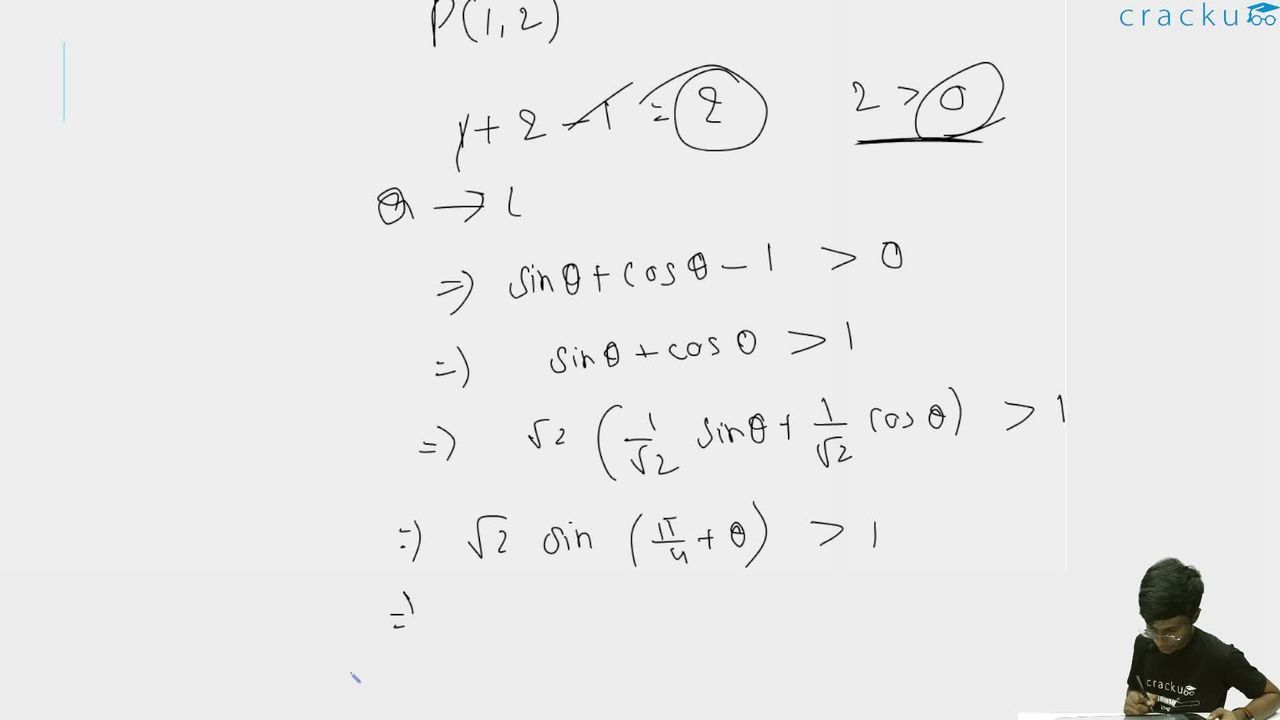
For any point $$P(x,y)$$ the algebraic expression $$x + y - 1$$ tells us on which side of the line $$x + y = 1$$ the point lies, because the line itself is described by $$x + y - 1 = 0$$.
We first evaluate this expression for the fixed point $$(1,2)$$.
Substituting $$x = 1,\; y = 2$$ we get
$$1 + 2 - 1 = 2.$$
The result $$2$$ is positive, so the point $$(1,2)$$ lies on the side of the line where the value of $$x + y - 1$$ is positive.
Now take the variable point $$(\sin\theta,\; \cos\theta)$$ with $$\theta \in (0,\pi)$$. Substituting $$x = \sin\theta,\; y = \cos\theta$$ in the same expression we obtain
$$\sin\theta + \cos\theta - 1.$$
For the two points to lie on the same side of the line, the signs of their respective expressions must be identical. Because the first expression is positive, the second must also be positive:
$$\sin\theta + \cos\theta - 1 > 0.$$
Re-arranging gives the key inequality
$$\sin\theta + \cos\theta > 1.$$
To solve this, we use the standard trigonometric identity
$$\sin\theta + \cos\theta = \sqrt{2}\,\sin\!\Bigl(\theta + \frac{\pi}{4}\Bigr).$$
Substituting the identity, the inequality becomes
$$\sqrt{2}\,\sin\!\Bigl(\theta + \frac{\pi}{4}\Bigr) > 1.$$
Dividing both sides by $$\sqrt{2}$$ (which is positive and hence preserves the inequality sign) we get
$$\sin\!\Bigl(\theta + \frac{\pi}{4}\Bigr) > \frac{1}{\sqrt{2}}.$$
Notice that $$\frac{1}{\sqrt{2}} = \sin\frac{\pi}{4},$$ so we can write
$$\sin\!\Bigl(\theta + \frac{\pi}{4}\Bigr) > \sin\frac{\pi}{4}.$$
Let $$\phi = \theta + \frac{\pi}{4}.$$ Because $$\theta \in (0,\pi),$$ adding $$\frac{\pi}{4}$$ shifts the interval, giving
$$\phi \in \Bigl(\frac{\pi}{4},\, \frac{5\pi}{4}\Bigr).$$
The inequality $$\sin\phi > \sin\frac{\pi}{4}$$ holds when $$\phi$$ is in the interval where the sine curve stays above its value at $$\frac{\pi}{4}.$$ On the principal interval $$[0,\pi]$$ the sine function rises from $$0$$ at $$0$$ to $$1$$ at $$\frac{\pi}{2}$$ and then falls back to $$0$$ at $$\pi$$. Thus
$$\sin\phi > \sin\frac{\pi}{4} \quad\Longleftrightarrow\quad \phi \in \Bigl(\frac{\pi}{4},\,\frac{3\pi}{4}\Bigr).$$
We now intersect this with the allowable range of $$\phi$$ obtained earlier:
$$\Bigl(\frac{\pi}{4},\,\frac{5\pi}{4}\Bigr)\;\cap\;\Bigl(\frac{\pi}{4},\,\frac{3\pi}{4}\Bigr) \;=\; \Bigl(\frac{\pi}{4},\,\frac{3\pi}{4}\Bigr).$$
Returning to $$\theta = \phi - \frac{\pi}{4},$$ we translate the interval back:
$$\theta \in \Bigl(\frac{\pi}{4} - \frac{\pi}{4},\, \frac{3\pi}{4} - \frac{\pi}{4}\Bigr) = (0,\frac{\pi}{2}).$$
Thus the required set of $$\theta$$ values is the open interval $$(0,\frac{\pi}{2}).$$
Hence, the correct answer is Option A.
Was this solution helpful?
Click on the Email ☝️ to Watch the Video Solution
Create a FREE account and get:
_1.webp)

Educational materials for JEE preparation

Ask our AI anything

AI can make mistakes. Please verify important information.
AI can make mistakes. Please verify important information.


