
Join Our JEE Preparation Group
Prep with like-minded aspirants; Get access to free daily tests and study material.
Sign in
Please select an account to continue using cracku.in
↓ →
Join Our JEE Preparation Group
Prep with like-minded aspirants; Get access to free daily tests and study material.
If the equation $$\cos^4\theta + \sin^4\theta + \lambda = 0$$ has real solutions for $$\theta$$ then $$\lambda$$ lies in interval:
We begin with the given equation
$$\cos^4\theta+\sin^4\theta+\lambda=0.$$
For real values of $$\theta$$ to exist, the trigonometric part $$\cos^4\theta+\sin^4\theta$$ must be equal to $$-\lambda$$ for some $$\theta$$. So we first find the range of the expression
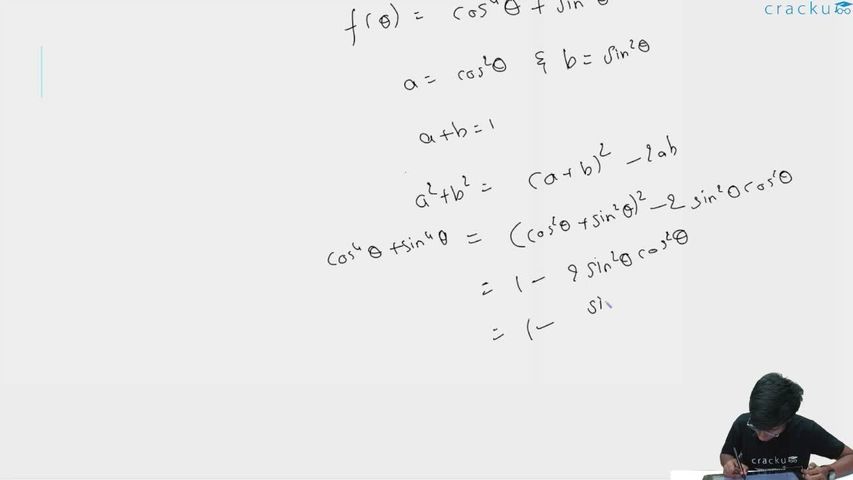
$$f(\theta)=\cos^4\theta+\sin^4\theta.$$
Write $$\cos^4\theta+\sin^4\theta$$ in terms of $$\cos^2\theta$$ and $$\sin^2\theta$$. Let
$$a=\cos^2\theta,\qquad b=\sin^2\theta.$$
We know the Pythagorean identity $$a+b=1$$ and, of course, $$0\le a\le1,\;0\le b\le1.$$ Using the algebraic identity $$a^2+b^2=(a+b)^2-2ab,$$ we have
$$\cos^4\theta+\sin^4\theta =a^2+b^2 =(a+b)^2-2ab =1^2-2ab =1-2\cos^2\theta\sin^2\theta.$$
Next, recall the double-angle formula $$\sin2\theta=2\sin\theta\cos\theta,$$ so that
$$\sin^22\theta=4\sin^2\theta\cos^2\theta \;\Longrightarrow\; \cos^2\theta\sin^2\theta=\dfrac{\sin^22\theta}{4}.$$
Substituting this into the previous expression gives
$$f(\theta)=1-2\left(\dfrac{\sin^22\theta}{4}\right) =1-\dfrac{1}{2}\sin^22\theta.$$
The term $$\sin^22\theta$$ always lies in the interval $$[0,1]$$ because the square of a sine function never exceeds 1 and is never negative. Hence
$$-\dfrac12\le -\dfrac{1}{2}\sin^22\theta\le0,$$ and adding 1 to every part we obtain the range of $$f(\theta):$$
$$\boxed{\dfrac12\le f(\theta)\le1}.$$
This means the expression $$\cos^4\theta+\sin^4\theta$$ can take any value from $$\dfrac12$$ up to $$1$$, inclusive.
Now the original equation can be written as
$$f(\theta)+\lambda=0 \;\Longrightarrow\; f(\theta)=-\lambda.$$
Thus, for some real $$\theta,$$ the number $$-\lambda$$ must lie in the interval $$\left[\dfrac12,1\right]$$ determined above. Multiplying that interval by $$-1$$ reverses the inequality signs, giving the permissible interval for $$\lambda:$$
$$-\left[\,\dfrac12,1\,\right]=\left[-1,-\dfrac12\right].$$
We include the endpoints because both $$\sin^22\theta=0$$ (giving $$f(\theta)=1$$) and $$\sin^22\theta=1$$ (giving $$f(\theta)=\dfrac12$$) are achievable for suitable values of $$\theta$$ (for example, $$\theta=0$$ and $$\theta=\dfrac{\pi}{4}$$ respectively).
Therefore
$$\boxed{\lambda\in\left[-1,-\dfrac12\right]}.$$
Among the given choices, this corresponds exactly to Option B.
Hence, the correct answer is Option B.
Was this solution helpful?
Click on the Email ☝️ to Watch the Video Solution
Create a FREE account and get:
_1.webp)

Educational materials for JEE preparation

Ask our AI anything

AI can make mistakes. Please verify important information.
AI can make mistakes. Please verify important information.


