
Join Our JEE Preparation Group
Prep with like-minded aspirants; Get access to free daily tests and study material.
Sign in
Please select an account to continue using cracku.in
↓ →
Join Our JEE Preparation Group
Prep with like-minded aspirants; Get access to free daily tests and study material.
The atomic number of the element from the following with lowest 1st ionisation enthalpy is :
The first-ionisation enthalpy is the energy required to remove the most loosely bound electron from a gaseous atom.
Periodic trend:
• Along a period (left → right) the ionisation enthalpy generally increases because nuclear charge increases while the atomic radius decreases.
• Down a group (top → bottom) the ionisation enthalpy generally decreases because atomic size increases and the outer electron is farther from the nucleus with greater shielding.
Therefore, the elements that lie farthest down the periodic table and belong to the extreme left (Group 1) will exhibit the lowest first-ionisation enthalpy.
Identify the elements corresponding to the given atomic numbers:
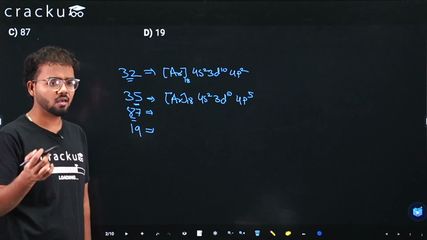
• $$32$$ → Ge (Group 14, Period 4)
• $$35$$ → Br (Group 17, Period 4)
• $$87$$ → Fr (Group 1, Period 7)
• $$19$$ → K (Group 1, Period 4)
Among these, both K and Fr are Group 1 elements, so they already have a lower ionisation enthalpy than Ge and Br.
Between K and Fr, Francium (Fr) lies lower in the same group (Period 7 vs. Period 4), so its atomic size is larger and the nuclear attraction on the outermost electron is weakest.
Hence the element with the lowest first-ionisation enthalpy is Francium, atomic number $$87$$.
Option C (atomic number 87) is correct.
Was this solution helpful?
Click on the Email ☝️ to Watch the Video Solution
Create a FREE account and get:
_1.webp)

Educational materials for JEE preparation

Ask our AI anything

AI can make mistakes. Please verify important information.
AI can make mistakes. Please verify important information.
