
Join Our JEE Preparation Group
Prep with like-minded aspirants; Get access to free daily tests and study material.
Sign in
Please select an account to continue using cracku.in
↓ →
Join Our JEE Preparation Group
Prep with like-minded aspirants; Get access to free daily tests and study material.
Let the line $$y = mx$$ and the ellipse $$2x^2 + y^2 = 1$$ intersect at a point P in the first quadrant. If the normal to this ellipse at P meets the co-ordinate axes at $$\left(-\frac{1}{3\sqrt{2}}, 0\right)$$ and $$(0, \beta)$$, then $$\beta$$ is equal to
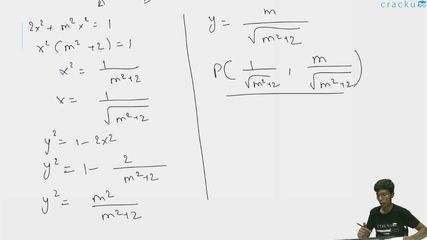
We have the ellipse $$2x^{2}+y^{2}=1$$ and the straight line $$y=mx$$. Putting $$y=mx$$ in the equation of the ellipse gives the co-ordinates of their point of intersection P:
$$2x^{2}+(mx)^{2}=1 \quad\Longrightarrow\quad (2+m^{2})x^{2}=1 \;\Longrightarrow\;x=\dfrac{1}{\sqrt{\,2+m^{2}}}.$$
Because the point lies in the first quadrant, $$x>0,\;y>0,$$ so
$$P\left(\dfrac{1}{\sqrt{\,2+m^{2}}},\;\dfrac{m}{\sqrt{\,2+m^{2}}}\right).$$
The slope of the tangent to the ellipse is obtained by implicit differentiation. Differentiating $$2x^{2}+y^{2}=1$$ gives
$$4x+2y\dfrac{dy}{dx}=0 \quad\Longrightarrow\quad \dfrac{dy}{dx}=-\dfrac{2x}{y}.$$
Therefore, at P
$$\text{slope of tangent}=m_{\text{tan}}=-\dfrac{2x_{P}}{y_{P}} =-\dfrac{2}{m}.$$
Since the normal is perpendicular to the tangent,
$$m_{\text{tan}}\;m_{\text{norm}}=-1 \;\Longrightarrow\; \left(-\dfrac{2}{m}\right)m_{\text{norm}}=-1 \;\Longrightarrow\; m_{\text{norm}}=\dfrac{m}{2}.$$
The normal at P is therefore
$$y-\dfrac{m}{\sqrt{\,2+m^{2}}} =\dfrac{m}{2}\!\left(x-\dfrac{1}{\sqrt{\,2+m^{2}}}\right).$$
This normal meets the x-axis at $$\!\left(-\dfrac{1}{3\sqrt{2}},\,0\right)\!.$$ Putting $$y=0$$ in the equation of the normal and letting $$x=x_{i}$$ gives
$$0-\dfrac{m}{\sqrt{\,2+m^{2}}} =\dfrac{m}{2}\!\left(x_{i}-\dfrac{1}{\sqrt{\,2+m^{2}}}\right).$$
Dividing by $$m\;(m\neq0)$$ and multiplying by 2, we get
$$-\dfrac{2}{\sqrt{\,2+m^{2}}}=x_{i}-\dfrac{1}{\sqrt{\,2+m^{2}}} \;\Longrightarrow\; x_{i}=-\dfrac{1}{\sqrt{\,2+m^{2}}}.$$
But the given x-intercept is $$-\dfrac{1}{3\sqrt{2}},$$ so
$$-\dfrac{1}{\sqrt{\,2+m^{2}}}=-\dfrac{1}{3\sqrt{2}} \;\Longrightarrow\; \sqrt{\,2+m^{2}}=3\sqrt{2} \;\Longrightarrow\; 2+m^{2}=18 \;\Longrightarrow\; m^{2}=16 \;\Longrightarrow\; m=4\;(\text{positive for first quadrant}).$$
Now we find the y-intercept. Put $$x=0$$ in the normal:
$$y-\dfrac{m}{\sqrt{\,2+m^{2}}} =\dfrac{m}{2}\!\left(0-\dfrac{1}{\sqrt{\,2+m^{2}}}\right) =-\dfrac{m}{2}\cdot\dfrac{1}{\sqrt{\,2+m^{2}}}.$$
Hence
$$y=\dfrac{m}{\sqrt{\,2+m^{2}}}-\dfrac{m}{2}\cdot\dfrac{1}{\sqrt{\,2+m^{2}}} =\dfrac{m}{\sqrt{\,2+m^{2}}}\left(1-\dfrac12\right) =\dfrac{m}{2\sqrt{\,2+m^{2}}}.$$
Substituting $$m=4$$ and $$\sqrt{\,2+m^{2}}=\sqrt{18}=3\sqrt{2},$$ we obtain
$$\beta=\dfrac{4}{2\cdot3\sqrt{2}} =\dfrac{2}{3\sqrt{2}} =\dfrac{\sqrt{2}}{3}.$$
Hence, the correct answer is Option D.
Was this solution helpful?
Click on the Email ☝️ to Watch the Video Solution
Create a FREE account and get:
_1.webp)

Educational materials for JEE preparation

Ask our AI anything

AI can make mistakes. Please verify important information.
AI can make mistakes. Please verify important information.
