
Join Our JEE Preparation Group
Prep with like-minded aspirants; Get access to free daily tests and study material.
Sign in
Please select an account to continue using cracku.in
↓ →
Join Our JEE Preparation Group
Prep with like-minded aspirants; Get access to free daily tests and study material.
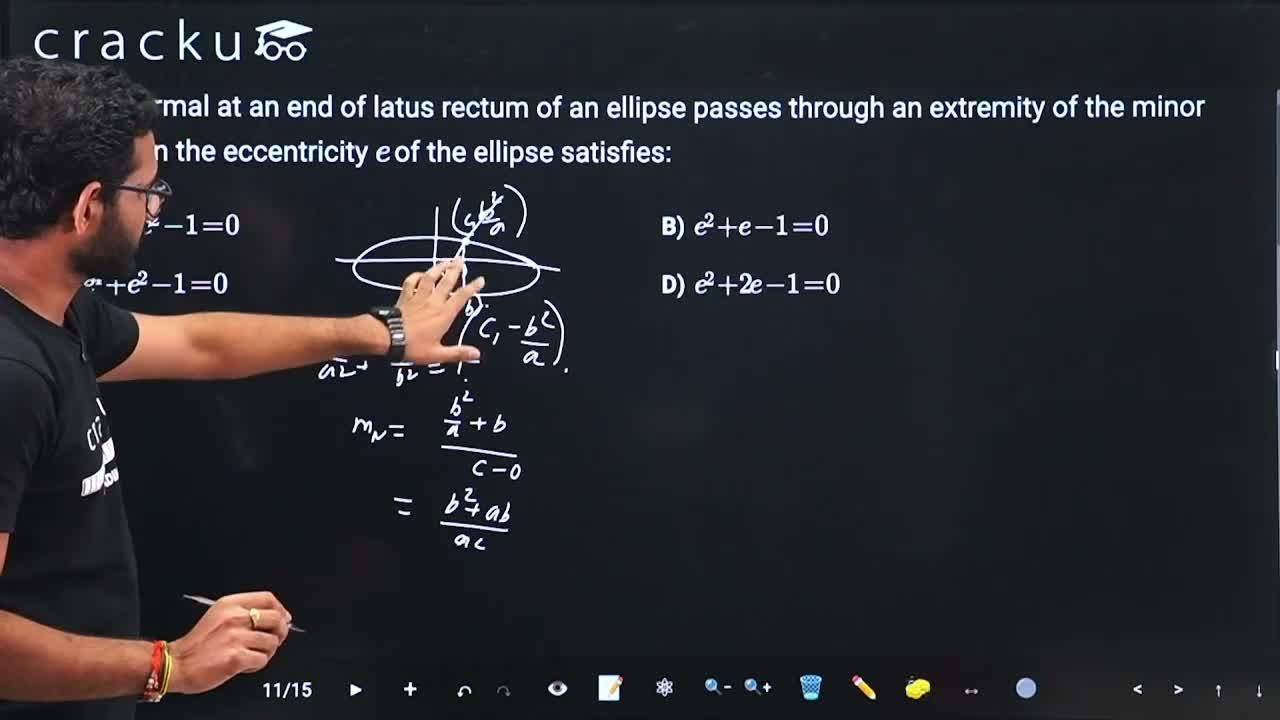
If the normal at an end of latus rectum of an ellipse passes through an extremity of the minor axis, then the eccentricity $$e$$ of the ellipse satisfies:
Let us take the ellipse in its standard (centre-origin, major axis on the X-axis) form
$$\frac{x^{2}}{a^{2}}+\frac{y^{2}}{b^{2}}=1,\qquad a>b>0.$$
For this ellipse we recall the following facts:
• The distance of each focus from the centre is $$c,$$ where $$c^{2}=a^{2}-b^{2}.$$
• The eccentricity is defined by $$e=\dfrac{c}{a},$$ so that $$e^{2}=\dfrac{c^{2}}{a^{2}}=\dfrac{a^{2}-b^{2}}{a^{2}}=1-\dfrac{b^{2}}{a^{2}}.$$
• The latus rectum corresponding to the focus $$(c,0)$$ is the line $$x=c,$$ and its two end-points on the ellipse are
$$\left(c,\;\;\frac{b^{2}}{a}\right)\quad\text{and}\quad\left(c,\;-\frac{b^{2}}{a}\right).$$
We choose the upper end of the latus rectum, namely
$$P\bigl(c,\;y_{1}\bigr)=\left(c,\;\frac{b^{2}}{a}\right).$$
The slope of the tangent at any point $$(x,y)$$ of the ellipse is obtained by implicit differentiation of the defining equation:
$$\frac{d}{dx}\!\left(\frac{x^{2}}{a^{2}}+\frac{y^{2}}{b^{2}}\right)=\frac{d}{dx}(1) \;\Longrightarrow\;\frac{2x}{a^{2}}+\frac{2y}{b^{2}}\frac{dy}{dx}=0,$$
hence
$$\frac{dy}{dx}=m_{t}=-\frac{b^{2}x}{a^{2}y}.$$
Therefore the slope of the normal is the negative reciprocal:
$$m_{n}=+\frac{a^{2}y}{b^{2}x}.$$
Evaluating this at the point $$P(c,\;b^{2}/a)$$ we get
$$m_{n}=\frac{a^{2}\,(b^{2}/a)}{b^{2}\,c}=\frac{a}{c}.$$
Thus the equation of the normal at $$P$$ is
$$y-\frac{b^{2}}{a}=\frac{a}{c}\Bigl(x-c\Bigr).$$
According to the statement of the problem, this normal line passes through an extremity of the minor axis. The extremities of the minor axis are $$(0,b)$$ and $$(0,-b).$$ Substituting $$(0,-b)$$ (we shall see that this choice gives a consistent, positive value of $$b$$) in the equation of the normal, we have
$$-b-\frac{b^{2}}{a}=\frac{a}{c}\bigl(0-c\bigr)=\frac{a}{c}(-c)=-a.$$
Collecting like terms:
$$-b-\frac{b^{2}}{a}+a=0.$$
Multiplying every term by $$a$$ to clear the denominator,
$$-ab-b^{2}+a^{2}=0,$$
or equivalently
$$a^{2}-ab-b^{2}=0.$$
Now we wish to express everything in terms of the single variable $$e.$$ For this purpose set
$$k=\frac{b}{a}\quad\bigl(\;0<k<1\;\bigr).$$
Dividing the last obtained relation by $$a^{2}$$ gives
$$1-k-k^{2}=0,$$
which can be written as
$$k^{2}+k-1=0.$$
Next we relate $$k$$ to $$e.$$ From the basic identity quoted earlier,
$$e^{2}=1-\frac{b^{2}}{a^{2}}=1-k^{2}.$$
Because $$k^{2}=1-k$$ from the quadratic immediately above, we substitute:
$$e^{2}=1-(1-k)=k.$$
Thus we have obtained
$$k=e^{2}.$$
Returning to the quadratic satisfied by $$k,$$ namely $$k^{2}+k-1=0,$$ we now replace $$k$$ by $$e^{2}:$$
$$\bigl(e^{2}\bigr)^{2}+e^{2}-1=0.$$
Simplifying,
$$e^{4}+e^{2}-1=0.$$
Hence, the correct answer is Option C.
Was this solution helpful?
Click on the Email ☝️ to Watch the Video Solution
Create a FREE account and get:
_1.webp)

Educational materials for JEE preparation

Ask our AI anything

AI can make mistakes. Please verify important information.
AI can make mistakes. Please verify important information.


