
Join Our JEE Preparation Group
Prep with like-minded aspirants; Get access to free daily tests and study material.
Sign in
Please select an account to continue using cracku.in
↓ →
Join Our JEE Preparation Group
Prep with like-minded aspirants; Get access to free daily tests and study material.
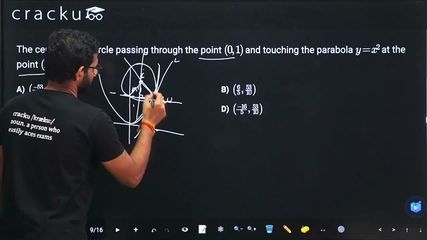
The centre of the circle passing through the point $$(0, 1)$$ and touching the parabola $$y = x^2$$ at the point $$(2, 4)$$ is:
We have to find the centre $$\,(h,k)\,$$ of a circle which
1. passes through the point $$(0,1)$$, and
2. touches (i.e. is tangent to) the parabola $$y=x^{2}$$ at the point $$(2,4)$$.
Whenever a circle is tangent to a curve at some point, the radius drawn to the point of contact is perpendicular to the tangent of the curve at that point. So our first task is to determine the tangent and then the normal (perpendicular) at $$(2,4)$$ on the parabola.
The parabola is $$y=x^{2}$$. Its derivative gives the slope of the tangent:
$$\frac{dy}{dx}=2x.$$
At $$x=2$$, the slope of the tangent is
$$m_{\text{tan}} = 2\cdot2 = 4.$$
The tangent line at $$(2,4)$$ therefore has slope 4. The slope of the normal (perpendicular) is the negative reciprocal of 4, namely $$-\tfrac14$$. Hence the equation of the normal through $$(2,4)$$ is
$$y-4=-\frac14\,(x-2).$$
Our centre $$(h,k)$$ must lie on this normal, so
$$k-4=-\frac14\,(h-2).$$
Multiplying by 4 to clear the denominator,
$$4(k-4)=-(h-2),$$
$$4k-16=-h+2,$$
$$h+4k-18=0.$$ We shall label this as equation $$(1).$$
Next we use the fact that the circle passes through two known points: the point of tangency $$(2,4)$$ and the point $$(0,1)$$. If $$r$$ is the radius, then
$$r^{2}=(2-h)^{2}+(4-k)^{2}\quad\text{and}\quad r^{2}=(h-0)^{2}+(k-1)^{2}.$$
Since both equal $$r^{2}$$, they are equal to each other:
$$(2-h)^{2}+(4-k)^{2}=h^{2}+(k-1)^{2}.$$
Now we expand each square fully, step by step:
$$(2-h)^{2}=h^{2}-4h+4,$$
$$(4-k)^{2}=k^{2}-8k+16,$$
$$(k-1)^{2}=k^{2}-2k+1.$$
Substituting these expansions into the equality gives
$$\bigl(h^{2}-4h+4\bigr)+\bigl(k^{2}-8k+16\bigr)=h^{2}+\bigl(k^{2}-2k+1\bigr).$$
Combining like terms on the left-hand side:
$$h^{2}+k^{2}-4h-8k+20 = h^{2}+k^{2}-2k+1.$$
Now we cancel $$h^{2}+k^{2}$$ from both sides:
$$-4h-8k+20 = -2k+1.$$
Bringing all terms to one side:
$$-4h-8k+20+2k-1=0,$$
$$-4h-6k+19=0.$$
Multiplying by $$-1$$ to make coefficients positive:
$$4h+6k-19=0.$$
This is our second linear relation between $$h$$ and $$k$$; call it equation $$(2).$$
We now solve the simultaneous linear equations:
$$(1)\;:\;h+4k-18=0,$$
$$(2)\;:\;4h+6k-19=0.$$
From equation $$(1)$$ we isolate $$h$$:
$$h=18-4k.$$
Substituting this value of $$h$$ into equation $$(2)$$:
$$4(18-4k)+6k-19=0,$$
$$72-16k+6k-19=0,$$
$$72-10k-19=0,$$
$$53-10k=0,$$
$$10k=53,$$
$$k=\frac{53}{10}.$$
Now we substitute $$k=\frac{53}{10}$$ back into $$h=18-4k$$:
$$h = 18 - 4\left(\frac{53}{10}\right)= 18 - \frac{212}{10} = \frac{180}{10} - \frac{212}{10} = -\frac{32}{10}= -\frac{16}{5}.$$
Thus the centre is
$$\left(h,k\right)=\left(-\frac{16}{5},\;\frac{53}{10}\right).$$
Comparing with the given options, this corresponds to Option D.
Hence, the correct answer is Option D.
Was this solution helpful?
Click on the Email ☝️ to Watch the Video Solution
Create a FREE account and get:
_1.webp)

Educational materials for JEE preparation

Ask our AI anything

AI can make mistakes. Please verify important information.
AI can make mistakes. Please verify important information.


