
Join Our JEE Preparation Group
Prep with like-minded aspirants; Get access to free daily tests and study material.
Sign in
Please select an account to continue using cracku.in
↓ →
Join Our JEE Preparation Group
Prep with like-minded aspirants; Get access to free daily tests and study material.
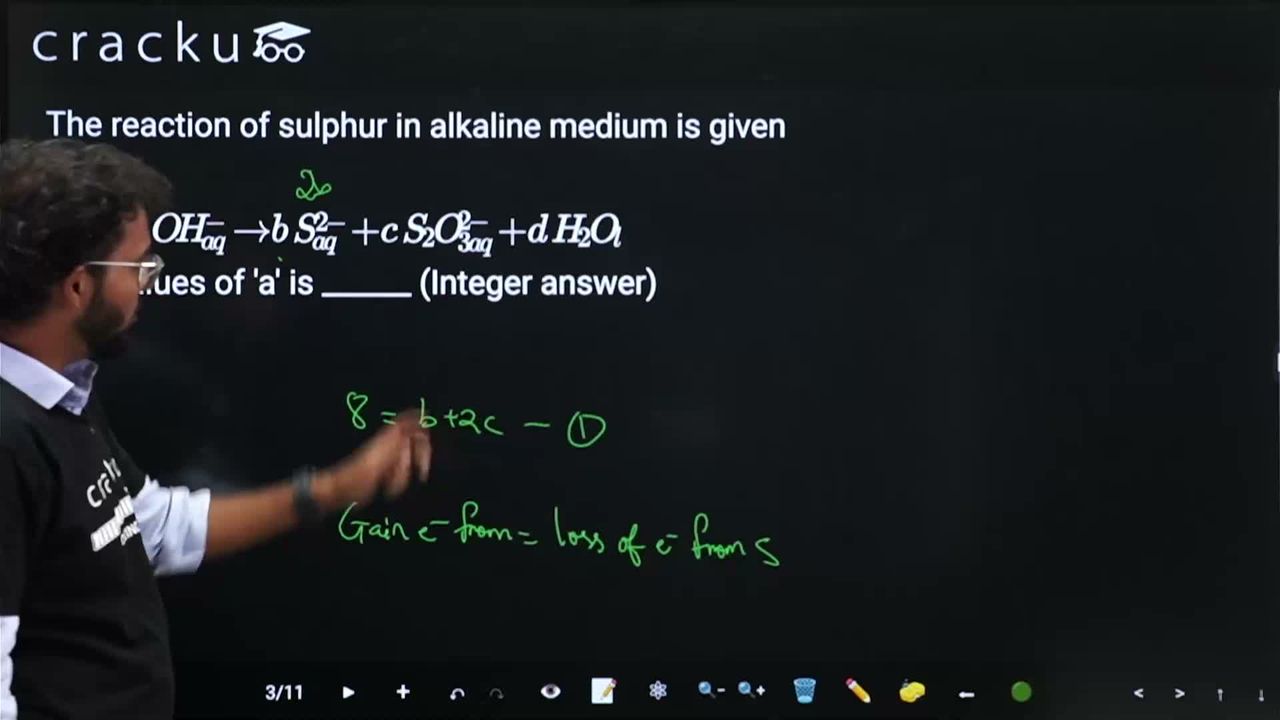
The reaction of sulphur in alkaline medium is given below:
$$S_{8s} + a \; OH^-_{aq} \to b \; S^{2-}_{aq} + c \; S_2O^{2-}_{3aq} + d \; H_2O_l$$
The values of 'a' is ______ (Integer answer)
Correct Answer: 12
We need to balance the reaction: $$S_{8}(s) + a \; OH^{-}(aq) \to b \; S^{2-}(aq) + c \; S_2O_3^{2-}(aq) + d \; H_2O(l)$$
This is a disproportionation reaction of sulphur in alkaline medium. Sulphur is simultaneously oxidised and reduced.
In $$S_8$$, the oxidation state of S is 0. In $$S^{2-}$$, it is $$-2$$. In $$S_2O_3^{2-}$$, the average oxidation state of S is $$+2$$.
Balancing sulphur atoms: $$8 = b + 2c$$
Balancing the change in oxidation state (electron transfer): each S going to $$S^{2-}$$ gains 2 electrons, so total electrons gained = $$2b$$. Each S going to $$S_2O_3^{2-}$$ loses 2 electrons, so total electrons lost = $$2 \times 2c = 4c$$. Wait — there are $$2c$$ sulphur atoms each losing 2 electrons, so total electrons lost = $$4c$$.
For electron balance: $$2b = 4c$$, which gives $$b = 2c$$.
Substituting in the sulphur balance: $$8 = 2c + 2c = 4c$$, so $$c = 2$$ and $$b = 4$$.
Now balancing oxygen: on the right side, we have $$c \times 3 = 6$$ oxygens from $$S_2O_3^{2-}$$ and $$d$$ oxygens from $$H_2O$$. On the left side, $$OH^-$$ contributes $$a$$ oxygens. So $$a = 6 + d$$.
Balancing hydrogen: $$a = 2d$$.
From $$a = 6 + d$$ and $$a = 2d$$: $$2d = 6 + d$$, so $$d = 6$$ and $$a = 12$$.
Let us verify the charge balance. Left side: $$-a = -12$$. Right side: $$-2b - 2c = -2(4) - 2(2) = -8 - 4 = -12$$. The charges balance.
The balanced equation is: $$S_8 + 12 \; OH^- \to 4 \; S^{2-} + 2 \; S_2O_3^{2-} + 6 \; H_2O$$
So, the answer is $$12$$.
Was this solution helpful?
Click on the Email ☝️ to Watch the Video Solution
Create a FREE account and get:
_1.webp)

Educational materials for JEE preparation

Ask our AI anything

AI can make mistakes. Please verify important information.
AI can make mistakes. Please verify important information.


