
Join Our JEE Preparation Group
Prep with like-minded aspirants; Get access to free daily tests and study material.
Sign in
Please select an account to continue using cracku.in
↓ →
Join Our JEE Preparation Group
Prep with like-minded aspirants; Get access to free daily tests and study material.
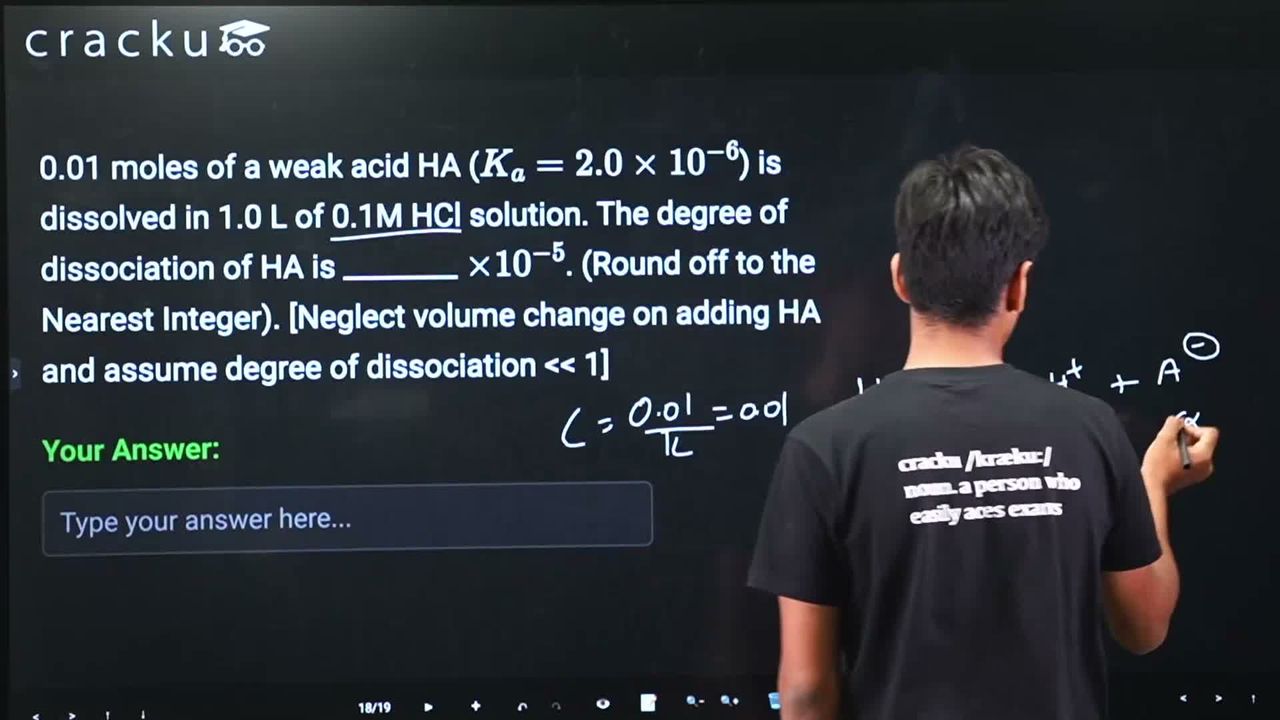
0.01 moles of a weak acid HA ($$K_a = 2.0 \times 10^{-6}$$) is dissolved in 1.0 L of 0.1M HCl solution. The degree of dissociation of HA is ________ $$\times 10^{-5}$$. (Round off to the Nearest Integer). [Neglect volume change on adding HA and assume degree of dissociation << 1]
Correct Answer: 2
The weak acid HA dissociates as $$HA \rightleftharpoons H^+ + A^-$$ with $$K_a = 2.0 \times 10^{-6}$$. When 0.01 mol of HA is dissolved in 1.0 L of 0.1 M HCl, the $$H^+$$ concentration from HCl is 0.1 M, which strongly suppresses the dissociation of HA (common ion effect).
Let $$\alpha$$ be the degree of dissociation of HA. Since $$\alpha \ll 1$$, the concentration of undissociated HA remains approximately $$C = 0.01$$ M. The $$A^-$$ concentration is $$C\alpha = 0.01\alpha$$, and the total $$[H^+] \approx 0.1$$ M (dominated by HCl).
Applying the equilibrium expression: $$K_a = \frac{[H^+][A^-]}{[HA]} = \frac{0.1 \times 0.01\alpha}{0.01} = 0.1\alpha$$. Solving for $$\alpha$$: $$\alpha = \frac{K_a}{0.1} = \frac{2.0 \times 10^{-6}}{0.1} = 2.0 \times 10^{-5}$$.
Expressed as $$\_\_ \times 10^{-5}$$, the degree of dissociation is 2.
Was this solution helpful?
Click on the Email ☝️ to Watch the Video Solution
Create a FREE account and get:
_1.webp)

Educational materials for JEE preparation

Ask our AI anything

AI can make mistakes. Please verify important information.
AI can make mistakes. Please verify important information.
