
Join Our JEE Preparation Group
Prep with like-minded aspirants; Get access to free daily tests and study material.
Sign in
Please select an account to continue using cracku.in
↓ →
Join Our JEE Preparation Group
Prep with like-minded aspirants; Get access to free daily tests and study material.
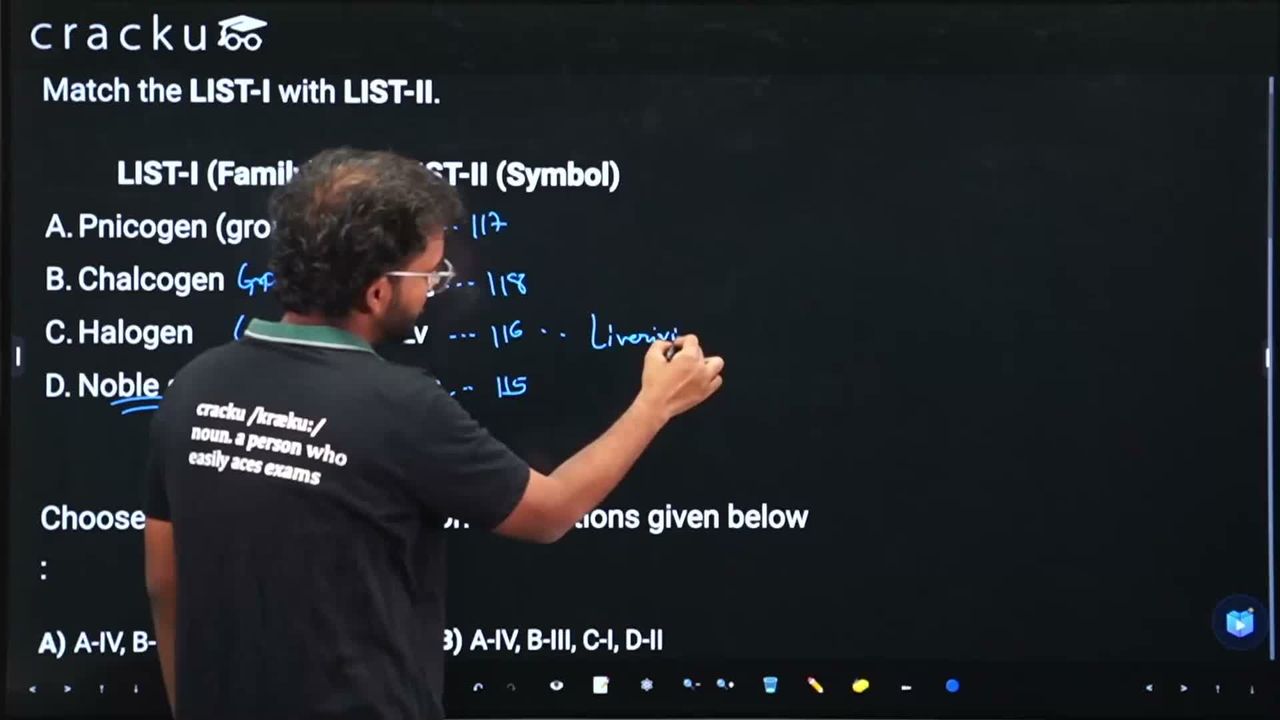
Match the LIST-I with LIST-II.
| LIST-I (Family) | LIST-II (Symbol) | ||
|---|---|---|---|
| A. | Pnicogen (group 15) | I. | Ts |
| B. | Chalcogen | II. | Og |
| C. | Halogen | III. | Lv |
| D. | Noble gas | IV. | Mc |
Choose the correct answer from the options given below :
Group-wise names used in the periodic table:
• Group 15 elements are called pnicogens (pnictogens).
• Group 16 elements are called chalcogens.
• Group 17 elements are called halogens.
• Group 18 elements are called noble gases.
Now locate each super-heavy element given in LIST-II:
Case 1: $$\mathbf{Mc}$$ (Moscovium) has atomic number $$115$$ and lies in Group $$15$$. Hence it belongs to the pnicogen family.
Case 2: $$\mathbf{Lv}$$ (Livermorium) has atomic number $$116$$ and lies in Group $$16$$. Hence it belongs to the chalcogen family.
Case 3: $$\mathbf{Ts}$$ (Tennessine) has atomic number $$117$$ and lies in Group $$17$$. Hence it belongs to the halogen family.
Case 4: $$\mathbf{Og}$$ (Oganesson) has atomic number $$118$$ and lies in Group $$18$$. Hence it belongs to the noble-gas family.
Therefore, the correct matching is:
A. Pnicogen → Mc (IV)
B. Chalcogen → Lv (III)
C. Halogen → Ts (I)
D. Noble gas → Og (II)
Thus the required option is:
Option B: A-IV, B-III, C-I, D-II
Click on the Email ☝️ to Watch the Video Solution
Create a FREE account and get:
_1.webp)

Educational materials for JEE preparation

Ask our AI anything

AI can make mistakes. Please verify important information.
AI can make mistakes. Please verify important information.


