
Join Our JEE Preparation Group
Prep with like-minded aspirants; Get access to free daily tests and study material.
Sign in
Please select an account to continue using cracku.in
↓ →
Join Our JEE Preparation Group
Prep with like-minded aspirants; Get access to free daily tests and study material.
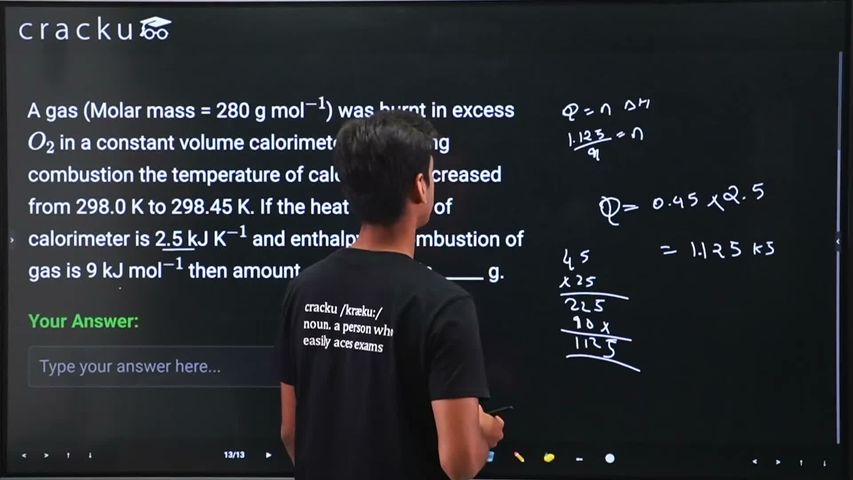
A gas (Molar mass = 280 g mol$$^{-1}$$) was burnt in excess $$O_2$$ in a constant volume calorimeter and during combustion the temperature of calorimeter increased from 298.0 K to 298.45 K. If the heat capacity of calorimeter is 2.5 kJ K$$^{-1}$$ and enthalpy of combustion of gas is 9 kJ mol$$^{-1}$$ then amount of gas burnt is _____ g.
Correct Answer: 35
We need to find the amount of gas burnt in a constant volume calorimeter.
The molar mass of the gas is 280 g mol$$^{-1}$$, the observed temperature rise is $$\Delta T = 298.45 - 298.0 = 0.45$$ K, the heat capacity of the calorimeter is $$C = 2.5$$ kJ K$$^{-1}$$, and the enthalpy of combustion is $$\Delta_c H = 9$$ kJ mol$$^{-1}$$.
The heat released is calculated by multiplying the calorimeter heat capacity by the temperature change:
$$q = C \times \Delta T = 2.5 \times 0.45 = 1.125 \text{ kJ}$$
This heat corresponds to the moles of gas burnt times the magnitude of the enthalpy of combustion:
$$q = n \times |\Delta_c H|$$
$$1.125 = n \times 9$$
$$n = \frac{1.125}{9} = 0.125 \text{ mol}$$
The mass of gas consumed follows from the number of moles and the molar mass:
$$\text{Mass} = n \times M = 0.125 \times 280 = 35 \text{ g}$$
Hence, the answer is 35 g.
Was this solution helpful?
Click on the Email ☝️ to Watch the Video Solution
Create a FREE account and get:
_1.webp)

Educational materials for JEE preparation

Ask our AI anything

AI can make mistakes. Please verify important information.
AI can make mistakes. Please verify important information.
