
Join Our JEE Preparation Group
Prep with like-minded aspirants; Get access to free daily tests and study material.
Sign in
Please select an account to continue using cracku.in
↓ →
Join Our JEE Preparation Group
Prep with like-minded aspirants; Get access to free daily tests and study material.
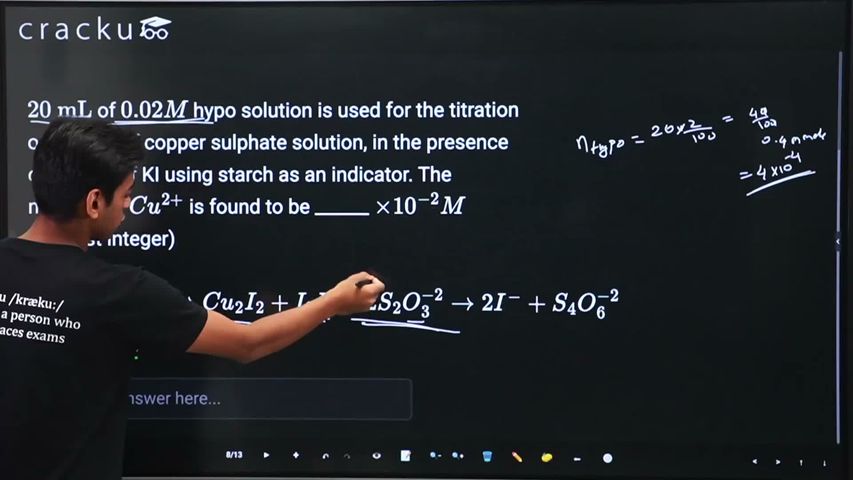
$$20 \text{ mL}$$ of $$0.02M$$ hypo solution is used for the titration of $$10 \text{ mL}$$ of copper sulphate solution, in the presence of excess of KI using starch as an indicator. The molarity of $$Cu^{2+}$$ is found to be ______ $$\times 10^{-2} M$$ (nearest integer)
Given : $$2Cu^{2+}+4I^{-}\rightarrow Cu_{2}I_{2} + I_{2}I_{2} + 2S_{2}O_{3}^{-2} \rightarrow 2I^{-} + S_{4}O_{6}^{-2}$$
Correct Answer: 4
We are given 20 mL of 0.02 M hypo (sodium thiosulphate, $$Na_2S_2O_3$$) solution, 10 mL of copper sulphate ($$CuSO_4$$) solution, and excess KI, and we need to find the molarity of $$Cu^{2+}$$.
Since $$2Cu^{2+} + 4I^- \rightarrow 2CuI \downarrow + I_2$$ in the presence of excess iodide ions, the liberated $$I_2$$ is then titrated with sodium thiosulphate according to $$I_2 + 2S_2O_3^{2-} \rightarrow 2I^- + S_4O_6^{2-}$$.
Substituting the values for the titration gives $$\text{Moles of } Na_2S_2O_3 = 0.02 \times \frac{20}{1000} = 4 \times 10^{-4} \text{ mol}$$, and because 1 mol of $$I_2$$ reacts with 2 mol of $$S_2O_3^{2-}$$, the moles of $$I_2$$ are $$\text{Moles of } I_2 = \frac{4 \times 10^{-4}}{2} = 2 \times 10^{-4} \text{ mol}$$.
Since 2 mol of $$Cu^{2+}$$ produce 1 mol of $$I_2$$, it follows that $$\text{Moles of } Cu^{2+} = 2 \times (2 \times 10^{-4}) = 4 \times 10^{-4} \text{ mol}$$.
Finally, dividing by the 10 mL (0.01 L) of $$Cu^{2+}$$ solution gives $$\text{Molarity} = \frac{\text{Moles}}{\text{Volume in litres}} = \frac{4 \times 10^{-4}}{10/1000} = \frac{4 \times 10^{-4}}{0.01} = 4 \times 10^{-2} \text{ M}$$. Therefore, the molarity of $$Cu^{2+}$$ is 4 $$\times 10^{-2}$$ M.
Was this solution helpful?
Click on the Email ☝️ to Watch the Video Solution
Create a FREE account and get:
_1.webp)

Educational materials for JEE preparation

Ask our AI anything

AI can make mistakes. Please verify important information.
AI can make mistakes. Please verify important information.
