
Join Our JEE Preparation Group
Prep with like-minded aspirants; Get access to free daily tests and study material.
Sign in
Please select an account to continue using cracku.in
↓ →
Join Our JEE Preparation Group
Prep with like-minded aspirants; Get access to free daily tests and study material.
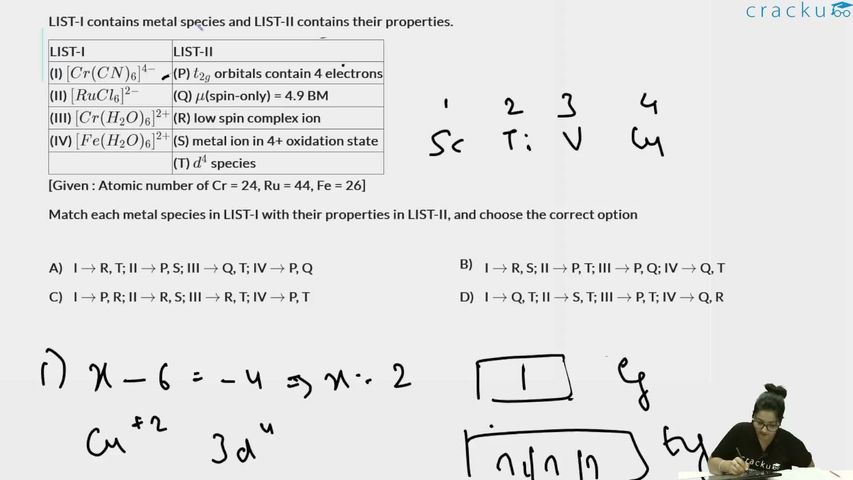
LIST-I contains metal species and LIST-II contains their properties.
| LIST-I | LIST-II |
|---|---|
| (I) $$[Cr(CN)_6]^{4-}$$ | (P) $$t_{2g}$$ orbitals contain 4 electrons |
| (II) $$[RuCl_6]^{2-}$$ | (Q) $$\mu$$(spin-only) = 4.9 BM |
| (III) $$[Cr(H_2O)_6]^{2+}$$ | (R) low spin complex ion |
| (IV) $$[Fe(H_2O)_6]^{2+}$$ | (S) metal ion in 4+ oxidation state |
| (T) $$d^4$$ species |
[Given : Atomic number of Cr = 24, Ru = 44, Fe = 26]
Match each metal species in LIST-I with their properties in LIST-II, and choose the correct option
First find for every complex
1. the oxidation state of the metal,
2. the corresponding $$d^{n}$$ configuration, and
3. whether the complex will be high-spin or low-spin.
From this we can decide the number of electrons in the $$t_{2g}$$ set, the spin-only magnetic moment $$\mu$$ (in Bohr magneton, BM) and any special oxidation state information.
Case I : $$[Cr(CN)_6]^{4-}$$
Let the oxidation state of chromium be $$x$$.
$$x + 6(-1) = -4 \;\Rightarrow\; x = +2$$
Cr has atomic number 24, so neutral chromium is $$[Ar]\,3d^5 4s^1$$.
Cr$$^{2+}$$ loses the two $$4s$$ electrons ⇒ $$d^{4}$$ species (property T).
$$CN^-$$ is a strong-field ligand; for a $$d^{4}$$ metal this gives the low-spin arrangement $$t_{2g}^4 e_g^0$$ (property R).
Hence I → R, T.
Case II : $$[RuCl_6]^{2-}$$
Let the oxidation state of ruthenium be $$x$$.
$$x + 6(-1) = -2 \;\Rightarrow\; x = +4$$ ⇒ property S.
Ru (Z = 44) : neutral configuration $$[Kr]\,4d^7 5s^1$$.
Removing four electrons (one 5s + three 4d) gives Ru$$^{4+}$$ = $$4d^{4}$$ ⇒ again a $$d^{4}$$ ion.
For 4d and 5d metals, even halide ligands usually generate a sufficiently large $$\Delta_o$$ to give low-spin complexes, so the electronic distribution is $$t_{2g}^4 e_g^0$$ (four electrons in $$t_{2g}$$ → property P).
Hence II → P, S.
Case III : $$[Cr(H_2O)_6]^{2+}$$
Water is neutral, so Cr remains in +2 oxidation state: $$d^{4}$$ ⇒ property T.
$$H_2O$$ is a weak-field ligand; 3d ions therefore adopt the high-spin pattern $$t_{2g}^3 e_g^1$$.
Number of unpaired electrons $$n = 4$$, so
$$\mu = \sqrt{n(n+2)} = \sqrt{4(4+2)} = \sqrt{24} \approx 4.9\ \text{BM}$$ ⇒ property Q.
Hence III → Q, T.
Case IV : $$[Fe(H_2O)_6]^{2+}$$
Water is neutral, so Fe is in +2 state. Fe (Z = 26) : neutral $$[Ar]\,3d^6 4s^2$$; Fe$$^{2+}$$ = $$3d^{6}$$.
With the weak-field ligand $$H_2O$$, the complex is high-spin: $$t_{2g}^4 e_g^2$$, so the $$t_{2g}$$ orbitals carry 4 electrons (property P).
Unpaired electrons $$n = 4$$, giving the same magnetic moment $$\mu \approx 4.9\ \text{BM}$$ (property Q).
Hence IV → P, Q.
Collecting all matches:
I → R, T II → P, S III → Q, T IV → P, Q
The option that lists exactly these pairings is Option A.
Was this solution helpful?
Click on the Email ☝️ to Watch the Video Solution
Create a FREE account and get:
_1.webp)

Educational materials for JEE preparation

Ask our AI anything

AI can make mistakes. Please verify important information.
AI can make mistakes. Please verify important information.
