
Join Our JEE Preparation Group
Prep with like-minded aspirants; Get access to free daily tests and study material.
Sign in
Please select an account to continue using cracku.in
↓ →
Join Our JEE Preparation Group
Prep with like-minded aspirants; Get access to free daily tests and study material.
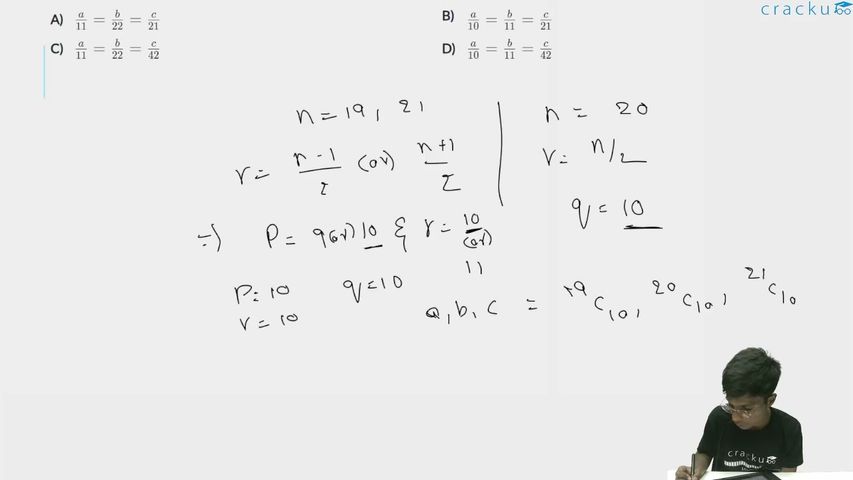
If a, b and c are the greatest values of $$^{19}C_p$$, $$^{20}C_q$$ and $$^{21}C_r$$ respectively, then:
For every binomial coefficient we recall the symmetry and monotonicity property
$$^nC_r = \; ^nC_{n-r}$$
and, starting from $$r = 0$$, the values of $$^nC_r$$ keep on increasing as $$r$$ increases up to the integral part of $$\dfrac{n}{2}$$, after which they start decreasing. This means that the greatest term (or terms) of the expansion of $$(1+x)^n$$ occur(s) at
$$r = \left\lfloor \dfrac{n}{2} \right\rfloor \quad\text{or}\quad r = \left\lceil \dfrac{n}{2} \right\rceil.$$
Now we apply this fact one by one.
For $$^{19}C_p$$ we have $$n = 19$$. The integral part of $$\dfrac{19}{2}$$ is $$9$$ and the next integer is $$10$$. Hence the greatest value is attained at $$p = 9$$ or $$p = 10$$, and both values are the same:
$$a = \;^{19}C_9 = \;^{19}C_{10}.$$
Using the factorial definition,
$$a = ^{19}C_9 = \dfrac{19!}{9!\,10!}.$$
Simplifying step by step,
$$\begin{aligned} a &= \dfrac{19\cdot18\cdot17\cdot16\cdot15\cdot14\cdot13\cdot12\cdot11}{9\cdot8\cdot7\cdot6\cdot5\cdot4\cdot3\cdot2\cdot1} \\ &= 92378. \end{aligned}$$
For $$^{20}C_q$$ we have $$n = 20$$. Now $$\dfrac{20}{2}=10$$, so the single greatest value is at $$q = 10$$.
$$b = \;^{20}C_{10} = \dfrac{20!}{10!\,10!}.$$
Again expanding only what is needed,
$$\begin{aligned} b &= \dfrac{20\cdot19\cdot18\cdot17\cdot16\cdot15\cdot14\cdot13\cdot12\cdot11}{10\cdot9\cdot8\cdot7\cdot6\cdot5\cdot4\cdot3\cdot2\cdot1} \\ &= 184756. \end{aligned}$$
For $$^{21}C_r$$ we take $$n = 21$$. Now $$\dfrac{21}{2}=10.5$$, so the two central positions $$r = 10$$ and $$r = 11$$ give the maximum and are equal:
$$c = \;^{21}C_{10} = \;^{21}C_{11}.$$
Using the recursive relation $$^{n}C_{r} = \;^{\,n-1}C_{r} + \;^{\,n-1}C_{r-1},$$
$$\begin{aligned} c &= ^{21}C_{10} \\ &= ^{20}C_{10} + \;^{20}C_{9} \\ &= 184756 + 167960 \\ &= 352716. \end{aligned}$$
We have therefore obtained
$$a = 92378,\qquad b = 184756,\qquad c = 352716.$$
Now we examine the ratios suggested by the four options. Start by dividing each number by the respective denominators in Option C:
$$ \begin{aligned} \dfrac{a}{11} &= \dfrac{92378}{11} = 8398,\\[4pt] \dfrac{b}{22} &= \dfrac{184756}{22} = 8398,\\[4pt] \dfrac{c}{42} &= \dfrac{352716}{42} = 8398. \end{aligned} $$
All three quotients are exactly equal to $$8398$$, so the three fractions are equal:
$$\frac{a}{11} = \frac{b}{22} = \frac{c}{42}.$$
No other option satisfies this equality; for example, under Option A we would have
$$\frac{c}{21}=16796 \neq 8398=\frac{a}{11}.$$
Hence, the correct answer is Option C.
Was this solution helpful?
Click on the Email ☝️ to Watch the Video Solution
Create a FREE account and get:
_1.webp)

Educational materials for JEE preparation

Ask our AI anything

AI can make mistakes. Please verify important information.
AI can make mistakes. Please verify important information.
