
Join Our JEE Preparation Group
Prep with like-minded aspirants; Get access to free daily tests and study material.
Sign in
Please select an account to continue using cracku.in
↓ →
Join Our JEE Preparation Group
Prep with like-minded aspirants; Get access to free daily tests and study material.
Given below are two statements :
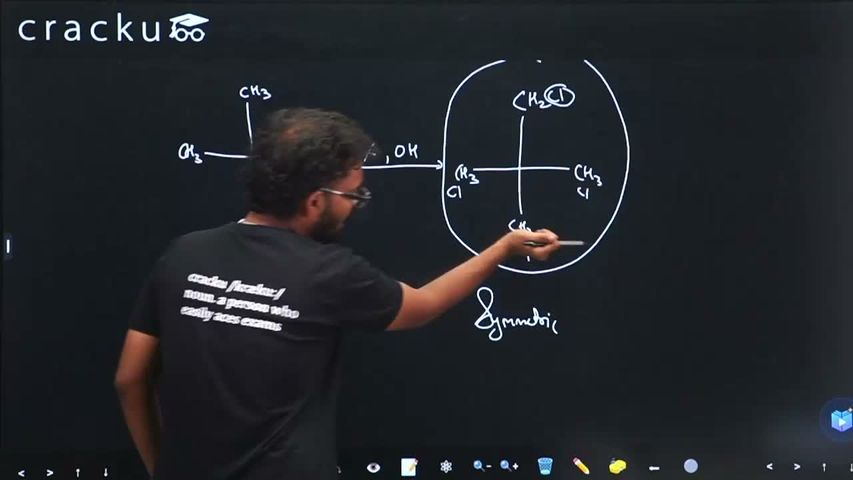
Statement (I) : Neopentane forms only one monosubstituted derivative.
Statement (II) : Melting point of neopentane is higher than n-pentane.
In the light of the above statements, choose the most appropriate answer from the options given below :
Structure of neopentane (also called $$2,2$$-dimethylpropane): it has a central $$C$$ atom attached to four $$CH_3$$ groups giving the formula $$C\,(CH_3)_4$$.
Case 1: Verifying Statement I - “Neopentane forms only one monosubstituted derivative.”
Every hydrogen in neopentane belongs to a $$CH_3$$ group that is equivalent by symmetry; each $$CH_3$$ is attached to the same central carbon. Therefore, replacing any one hydrogen (by $$Cl$$, $$Br$$, $$OH$$, etc.) always gives the same product. Hence only one type of monosubstituted derivative is possible.
Thus, Statement I is correct.
Case 2: Verifying Statement II - “Melting point of neopentane is higher than n-pentane.”
Melting point depends on how well molecules fit into a crystal lattice. Neopentane has an almost spherical shape, so its molecules pack efficiently, giving stronger intermolecular van der Waals attractions in the solid state. In contrast, n-pentane is elongated, packs less efficiently, and therefore melts at a lower temperature.
Experimental data confirm: mp (neopentane) ≈ $$-16^\circ\mathrm C$$, mp (n-pentane) ≈ $$-130^\circ\mathrm C$$. Hence, Statement II is also correct.
Since both statements are correct, the appropriate choice is Option B.
Was this solution helpful?
Click on the Email ☝️ to Watch the Video Solution
Create a FREE account and get:
_1.webp)

Educational materials for JEE preparation

Ask our AI anything

AI can make mistakes. Please verify important information.
AI can make mistakes. Please verify important information.


