
Join Our JEE Preparation Group
Prep with like-minded aspirants; Get access to free daily tests and study material.
Sign in
Please select an account to continue using cracku.in
↓ →
Join Our JEE Preparation Group
Prep with like-minded aspirants; Get access to free daily tests and study material.
The species having identical radii according to the Bohr's theory are:
A. H (first orbit)
B. He$$^+$$ (first orbit)
C. He$$^+$$ (Second orbit)
D. Li$$^{2+}$$ (first orbit)
E. Be$$^{3+}$$ (Second orbit)
Choose the correct answer from the options given below:
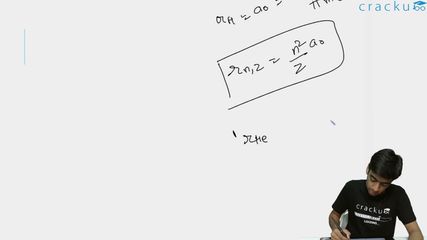
For a hydrogen-like species (only one electron), Bohr’s radius formula is
$$r_n = a_0\,\frac{n^{2}}{Z}$$
where $$a_0 = 0.529\ \text{Å}$$ is the Bohr radius, $$n$$ is the principal quantum number (orbit number) and $$Z$$ is the nuclear charge.
Calculate $$r_n$$ for every species mentioned:
Case A: $$\text{H (1st orbit)}$$ ⇒ $$Z = 1,\ n = 1$$
$$r = a_0\,\frac{1^{2}}{1} = a_0$$
Case B: $$\text{He}^+ \text{ (1st orbit)}$$ ⇒ $$Z = 2,\ n = 1$$
$$r = a_0\,\frac{1^{2}}{2} = \frac{a_0}{2}$$
Case C: $$\text{He}^+ \text{ (2nd orbit)}$$ ⇒ $$Z = 2,\ n = 2$$
$$r = a_0\,\frac{2^{2}}{2} = 2a_0$$
Case D: $$\text{Li}^{2+} \text{ (1st orbit)}$$ ⇒ $$Z = 3,\ n = 1$$
$$r = a_0\,\frac{1^{2}}{3} = \frac{a_0}{3}$$
Case E: $$\text{Be}^{3+} \text{ (2nd orbit)}$$ ⇒ $$Z = 4,\ n = 2$$
$$r = a_0\,\frac{2^{2}}{4} = a_0$$
Comparing the radii:
• Case A gives $$r = a_0$$.
• Case E also gives $$r = a_0$$.
No other cases match each other.
Hence the species having identical radii are H (1st orbit) and Be$$^{3+}$$ (2nd orbit).
Option B which is: A, E Only
Was this solution helpful?
Click on the Email ☝️ to Watch the Video Solution
Create a FREE account and get:
_1.webp)

Educational materials for JEE preparation

Ask our AI anything

AI can make mistakes. Please verify important information.
AI can make mistakes. Please verify important information.


