
Join Our JEE Preparation Group
Prep with like-minded aspirants; Get access to free daily tests and study material.
Sign in
Please select an account to continue using cracku.in
↓ →
Join Our JEE Preparation Group
Prep with like-minded aspirants; Get access to free daily tests and study material.
The correct order of total number of atoms in: (A) 2 moles of cyclohexane, (B) 684 g of sucrose, (C) 90.8 L of dihydrogen at STP, is :
We must compare the total number of atoms present in each of the three given samples.
Avogadro’s law: $$1\text{ mol}$$ of any substance contains $$N_A = 6.022 \times 10^{23}$$ particles (molecules, atoms, ions, etc.).
At STP, $$1\text{ mol}$$ of any gas occupies $$22.4\text{ L}$$.
Case A:
Cyclohexane formula: $$C_6H_{12}$$.
Atoms in one molecule $$= 6 + 12 = 18$$.
Moles given $$= 2$$.
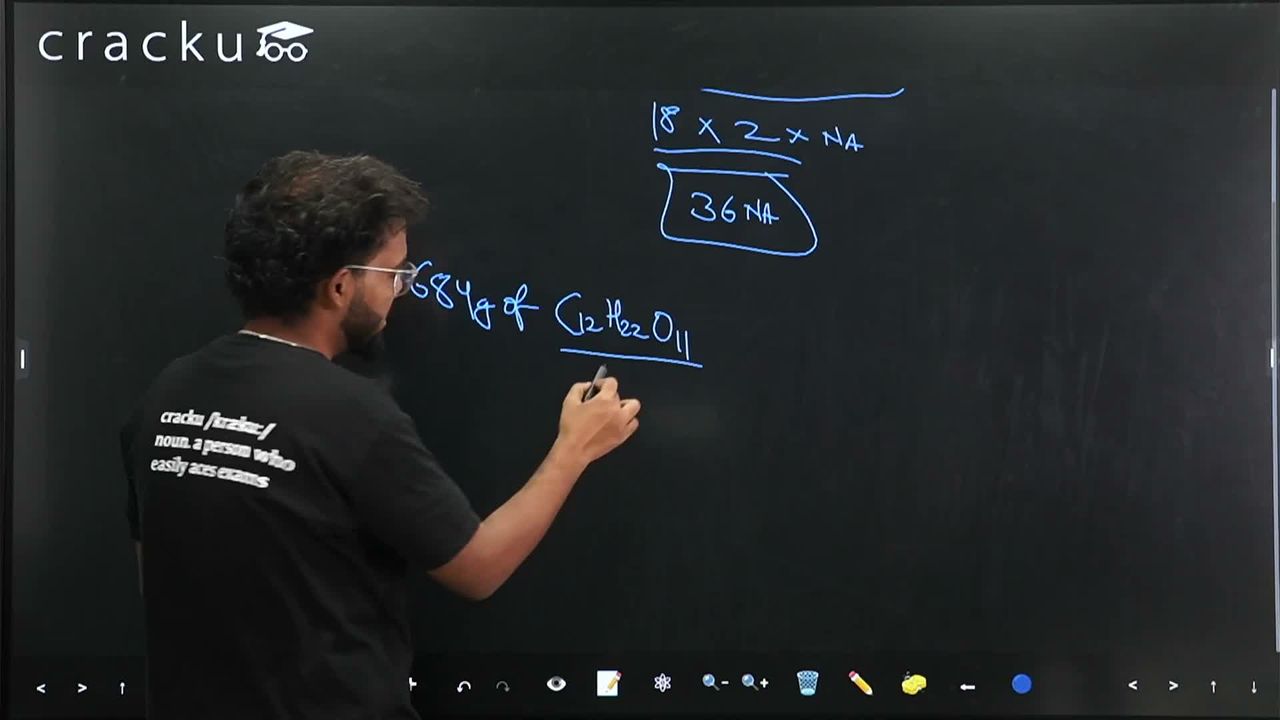
Total atoms $$= 2 \times 18 \times N_A = 36\,N_A$$.
Case B:
Sucrose formula: $$C_{12}H_{22}O_{11}$$.
Molar mass $$= 342\text{ g mol}^{-1}$$.
Mass given $$= 684\text{ g}$$.
Moles $$= \dfrac{684}{342} = 2$$.
Atoms in one molecule $$= 12 + 22 + 11 = 45$$.
Total atoms $$= 2 \times 45 \times N_A = 90\,N_A$$.
Case C:
Dihydrogen formula: $$H_2$$.
Volume given $$= 90.8\text{ L}$$.
Moles $$= \dfrac{90.8}{22.4} \approx 4.05$$.
Atoms in one molecule $$= 2$$.
Total atoms $$\approx 4.05 \times 2 \times N_A \approx 8.1\,N_A$$.
Comparing totals: $$90\,N_A \gt 36\,N_A \gt 8.1\,N_A$$.
Therefore: sucrose (B) has the most atoms, followed by cyclohexane (A), and dihydrogen (C) has the least.
Hence the correct order is $$\text{B} \gt \text{A} \gt \text{C}$$.
Option D which is: B > A > C.
Was this solution helpful?
Click on the Email ☝️ to Watch the Video Solution
Create a FREE account and get:
_1.webp)

Educational materials for JEE preparation

Ask our AI anything

AI can make mistakes. Please verify important information.
AI can make mistakes. Please verify important information.


