
Join Our JEE Preparation Group
Prep with like-minded aspirants; Get access to free daily tests and study material.
Sign in
Please select an account to continue using cracku.in
↓ →
Join Our JEE Preparation Group
Prep with like-minded aspirants; Get access to free daily tests and study material.
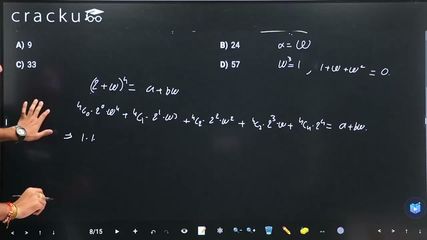
If $$a$$ and $$b$$ are real numbers such that $$(2 + \alpha)^4 = a + b\alpha$$, where $$\alpha = \frac{-1 + i\sqrt{3}}{2}$$, then $$a + b$$ is equal to:
We are asked to evaluate $$(2+\alpha)^4$$ where $$\alpha=\dfrac{-1+i\sqrt3}{2}$$ and then write the result in the form $$a+b\alpha$$ with real numbers $$a$$ and $$b$$. Afterwards we will calculate $$a+b$$.
First recall that $$\alpha$$ is a non-real cube root of unity. Hence it satisfies the standard relations
$$\alpha^3 = 1$$ and $$1+\alpha+\alpha^2 = 0.$$
From $$1+\alpha+\alpha^2=0$$ we obtain the very useful identity
$$\alpha^2 = -1-\alpha.$$
Now we expand $$(2+\alpha)^4$$ with the Binomial Theorem. The theorem states that for any numbers $$x$$ and $$y$$,
$$ (x+y)^4=\;^4C_0x^4+\;^4C_1x^3y+\;^4C_2x^2y^2+\;^4C_3xy^3+\;^4C_4y^4,$$
where the binomial coefficients for the fourth power are $$^4C_0=1,\;^4C_1=4,\;^4C_2=6,\;^4C_3=4,\;^4C_4=1.$$
Putting $$x=2$$ and $$y=\alpha$$, we get
$$ (2+\alpha)^4 = 2^4\;+\;4\cdot2^3\alpha\;+\;6\cdot2^2\alpha^2\;+\;4\cdot2\alpha^3\;+\;\alpha^4. $$
Compute each numerical power of 2 first:
$$2^4=16,\qquad2^3=8,\qquad2^2=4.$$
Substituting these values,
$$ (2+\alpha)^4 = 16 \;+\; 4\cdot8\,\alpha \;+\; 6\cdot4\,\alpha^2 \;+\; 4\cdot2\,\alpha^3 \;+\; \alpha^4, $$
which simplifies to
$$ (2+\alpha)^4 = 16 \;+\; 32\alpha \;+\; 24\alpha^2 \;+\; 8\alpha^3 \;+\; \alpha^4. $$
We now reduce all higher powers of $$\alpha$$ using the identities already stated.
First, $$\alpha^3=1,$$ so
$$8\alpha^3 = 8\cdot1 = 8.$$
Next, $$\alpha^2=-1-\alpha,$$ so
$$24\alpha^2 = 24(-1-\alpha) = -24 - 24\alpha.$$
Finally, $$\alpha^4 = \alpha\cdot\alpha^3 = \alpha\cdot1 = \alpha.$$
Substituting each of these back into the expansion:
$$ (2+\alpha)^4 = 16 \;+\; 32\alpha \;+\;(-24 - 24\alpha) \;+\; 8 \;+\; \alpha. $$
Now collect the constant (real) terms and the coefficients of $$\alpha$$ separately.
Constant terms: $$16 + (-24) + 8 = 0.$$
$$\alpha$$ terms: $$32\alpha + (-24\alpha) + \alpha = (32-24+1)\alpha = 9\alpha.$$
Hence we have obtained the very compact result
$$ (2+\alpha)^4 = 0 + 9\alpha = 9\alpha. $$
In other words, $$a=0$$ and $$b=9.$$ Therefore,
$$a+b = 0+9 = 9.$$
Hence, the correct answer is Option A.
Was this solution helpful?
Click on the Email ☝️ to Watch the Video Solution
Create a FREE account and get:
_1.webp)

Educational materials for JEE preparation

Ask our AI anything

AI can make mistakes. Please verify important information.
AI can make mistakes. Please verify important information.


