
Join Our JEE Preparation Group
Prep with like-minded aspirants; Get access to free daily tests and study material.
Sign in
Please select an account to continue using cracku.in
↓ →
Join Our JEE Preparation Group
Prep with like-minded aspirants; Get access to free daily tests and study material.
Let $$\alpha$$ and $$\beta$$ be the roots of the equation $$x^2 - x - 1 = 0$$. If $$p_k = (\alpha)^k + (\beta)^k$$, $$k \ge 1$$, then which one of the following statements is not true?
We have the quadratic equation $$x^{2}-x-1=0$$ whose roots are $$\alpha$$ and $$\beta$$. By Vieta’s formula (which states that for $$ax^{2}+bx+c=0$$ we get $$\alpha+\beta=-\frac{b}{a}$$ and $$\alpha\beta=\frac{c}{a}$$), we obtain
$$\alpha+\beta = 1 \qquad\text{and}\qquad \alpha\beta = -1.$$
Now, since each root satisfies the original equation, we can write
$$\alpha^{2}-\alpha-1 = 0 \quad\Longrightarrow\quad \alpha^{2}=\alpha+1,$$
$$\beta^{2}-\beta-1 = 0 \quad\Longrightarrow\quad \beta^{2}=\beta+1.$$
Adding these two equalities gives a very useful recurrence for the sequence $$p_k=\alpha^{k}+\beta^{k}$$:
$$p_2=\alpha^{2}+\beta^{2}=(\alpha+1)+(\beta+1)=\alpha+\beta+2=1+2=3.$$
Because $$\alpha^{2}=\alpha+1$$ and $$\beta^{2}=\beta+1$$, if we multiply both sides by $$\alpha^{m-2}$$ or $$\beta^{m-2}$$ respectively (for $$m\ge 2$$) and then add, we arrive at
$$\alpha^{m}+\beta^{m}=\alpha^{m-1}+\beta^{m-1}+\alpha^{m-2}+\beta^{m-2},$$
that is,
$$p_m = p_{m-1}+p_{m-2},\qquad m\ge 2.$$
This is exactly the Fibonacci-type (linear homogeneous) recurrence relation. Using the already known initial values
$$p_0=\alpha^{0}+\beta^{0}=1+1=2,\qquad p_1=\alpha+\beta=1,$$
we can generate subsequent terms one by one:
$$\begin{aligned} p_2 &= p_1+p_0 = 1+2 = 3,\\ p_3 &= p_2+p_1 = 3+1 = 4,\\ p_4 &= p_3+p_2 = 4+3 = 7,\\ p_5 &= p_4+p_3 = 7+4 = 11. \end{aligned}$$
With these exact numerical values in hand, let us inspect each option.
Option A: $$p_3=p_5-p_4\;?$$ We have $$p_5-p_4 = 11-7 = 4 = p_3,$$ so this statement is true.
Option B: $$p_5 = 11\;?$$ Our calculation gives $$p_5=11,$$ so this statement is also true.
Option C: $$(p_1+p_2+p_3+p_4+p_5)=26\;?$$ Adding, $$1+3+4+7+11 = 26,$$ so this statement is true as well.
Option D: $$p_5 = p_2\cdot p_3\;?$$ The right-hand side equals $$p_2p_3 = 3\times 4 = 12,$$ while the left-hand side is $$p_5 = 11.$$ Since $$11\neq 12,$$ this statement is false.
Therefore the only statement that is not true is Option D.
Hence, the correct answer is Option 4.
Was this solution helpful?
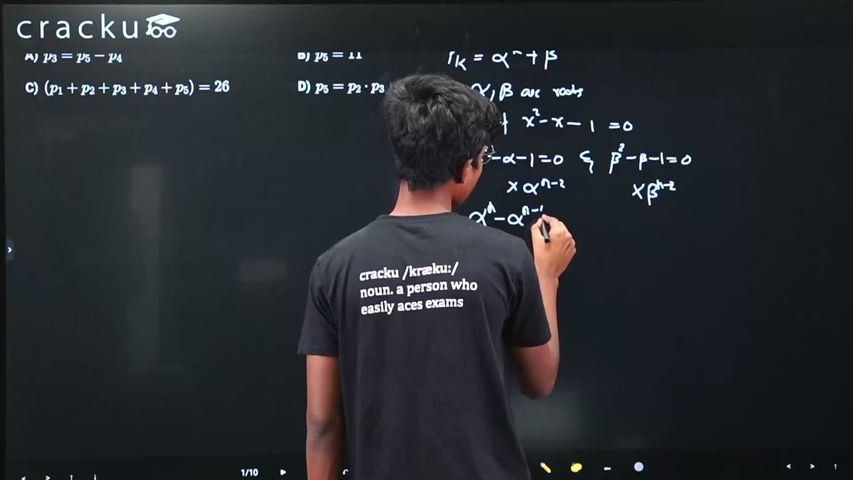
Click on the Email ☝️ to Watch the Video Solution
Create a FREE account and get:
_1.webp)

Educational materials for JEE preparation

Ask our AI anything

AI can make mistakes. Please verify important information.
AI can make mistakes. Please verify important information.
