
Join Our JEE Preparation Group
Prep with like-minded aspirants; Get access to free daily tests and study material.
Sign in
Please select an account to continue using cracku.in
↓ →
Join Our JEE Preparation Group
Prep with like-minded aspirants; Get access to free daily tests and study material.
To solve this summation, we use the method of Partial Fractions (specifically the "Method of Differences" or Telescoping Series) to simplify the general term.
The general term is:
$$T_n = \frac{528}{n(n+1)(n+2)}$$
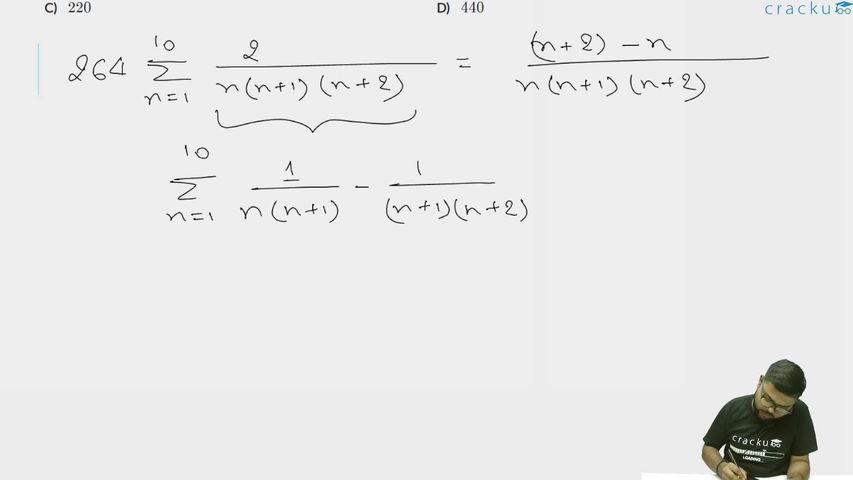
We can decompose this by noticing that the difference between the first and last factors in the denominator is $$(n+2) - n = 2$$. Let's rewrite the numerator:
$$T_n = \frac{528}{2} \cdot \frac{2}{n(n+1)(n+2)}$$
$$T_n = 264 \left[ \frac{(n+2) - n}{n(n+1)(n+2)} \right]$$
$$T_n = 264 \left[ \frac{n+2}{n(n+1)(n+2)} - \frac{n}{n(n+1)(n+2)} \right]$$
$$T_n = 264 \left[ \frac{1}{n(n+1)} - \frac{1}{(n+1)(n+2)} \right]$$
Now we sum $$T_n$$ from $$n=1$$ to $$10$$:
$$S = 264 \sum_{n=1}^{10} \left( \frac{1}{n(n+1)} - \frac{1}{(n+1)(n+2)} \right)$$
Let's write out the first few and the last terms to see how they cancel:
Notice that all middle terms cancel out, leaving only the first and the last:
$$S = 264 \left[ \frac{1}{1 \cdot 2} - \frac{1}{11 \cdot 12} \right]$$
$$S = 264 \left[ \frac{1}{2} - \frac{1}{132} \right]$$
Find a common denominator inside the brackets:
$$S = 264 \left[ \frac{66 - 1}{132} \right]$$
$$S = 264 \left[ \frac{65}{132} \right]$$
Since $$264 = 2 \times 132$$:
$$S = 2 \times 65 = 130$$
Final Answer: 130 (Option B)
Was this solution helpful?
Click on the Email ☝️ to Watch the Video Solution
Create a FREE account and get:
_1.webp)

Educational materials for JEE preparation

Ask our AI anything

AI can make mistakes. Please verify important information.
AI can make mistakes. Please verify important information.


