
Join Our JEE Preparation Group
Prep with like-minded aspirants; Get access to free daily tests and study material.
Sign in
Please select an account to continue using cracku.in
↓ →
Join Our JEE Preparation Group
Prep with like-minded aspirants; Get access to free daily tests and study material.
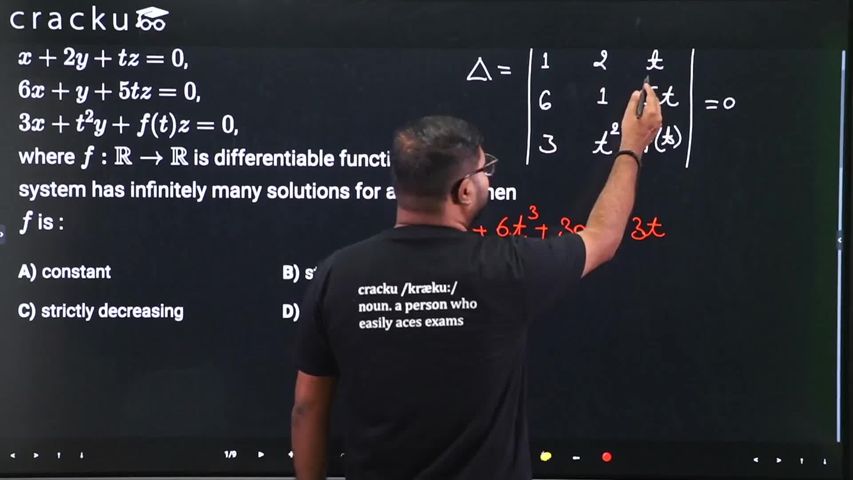
Consider the system of equations in $$x, y, z$$:
$$x + 2y + tz = 0$$,
$$6x + y + 5tz = 0$$,
$$3x + t^2 y + f(t)z = 0$$,
where $$f: \mathbb{R} \to \mathbb{R}$$ is differentiable function. If this system has infinitely many solutions for all $$t \in \mathbb{R}$$, then $$f$$ is :
To find the nature of the function $$f(t)$$, we use the condition for a homogeneous system of linear equations to have infinitely many solutions. This occurs when the determinant of the coefficient matrix ($$\Delta$$) is zero.
1. Set up the Determinant
The system is:
For infinitely many solutions, we must have:
$$\Delta = \begin{vmatrix} 1 & 2 & t \\ 6 & 1 & 5t \\ 3 & t^2 & f(t) \end{vmatrix} = 0$$
2. Expand the Determinant
Expanding along the first row:
$$1(f(t) - 5t^3) - 2(6f(t) - 15t) + t(6t^2 - 3) = 0$$
Now, simplify the expression:
$$f(t) - 5t^3 - 12f(t) + 30t + 6t^3 - 3t = 0$$
$$-11f(t) + t^3 + 27t = 0$$
Isolating $$f(t)$$:
$$11f(t) = t^3 + 27t$$
$$f(t) = \frac{1}{11}(t^3 + 27t)$$
3. Determine the Nature of $$f(t)$$
To see if the function is increasing or decreasing, we find its derivative $$f'(t)$$:
$$f'(t) = \frac{1}{11}(3t^2 + 27)$$
$$f'(t) = \frac{3}{11}(t^2 + 9)$$
Since $$t^2$$ is always $$\ge 0$$, the term $$(t^2 + 9)$$ is always positive (specifically, $$\ge 9$$) for all real values of $$t$$.
Therefore, $$f'(t) > 0$$ for all $$t \in \mathbb{R}$$.
Because the derivative is always positive, the function $$f(t)$$ is strictly increasing.
Correct Answer: B (strictly increasing)
Was this solution helpful?
Click on the Email ☝️ to Watch the Video Solution
Create a FREE account and get:
_1.webp)

Educational materials for JEE preparation

Ask our AI anything

AI can make mistakes. Please verify important information.
AI can make mistakes. Please verify important information.


