
Join Our JEE Preparation Group
Prep with like-minded aspirants; Get access to free daily tests and study material.
Sign in
Please select an account to continue using cracku.in
↓ →
Join Our JEE Preparation Group
Prep with like-minded aspirants; Get access to free daily tests and study material.
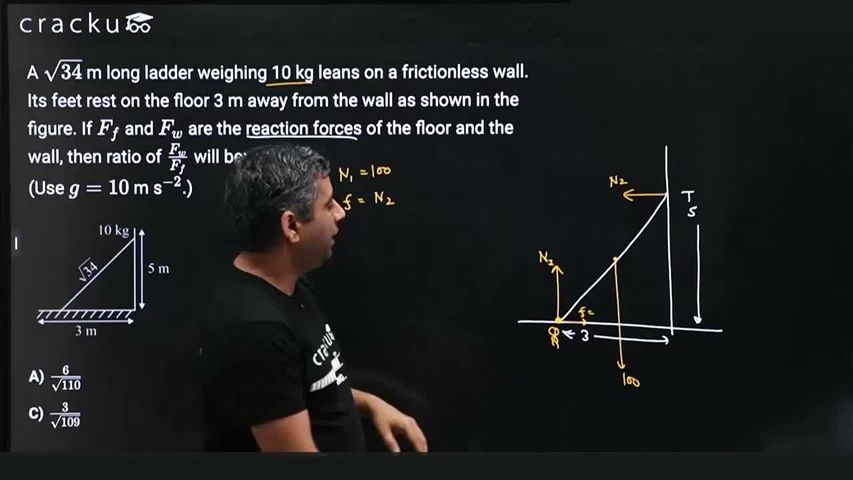
A $$\sqrt{34}$$ m long ladder weighing 10 kg leans on a frictionless wall. Its feet rest on the floor 3 m away from the wall as shown in the figure. If $$F_f$$ and $$F_w$$ are the reaction forces of the floor and the wall, then ratio of $$\frac{F_w}{F_f}$$ will be:
(Use $$g = 10$$ m s$$^{-2}$$.)
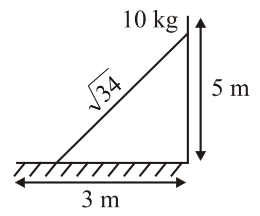
$$Length=\sqrt{\ 34},base=3m⇒height=5m$$
$$Weight=10g=100Nactingatmidpoint$$
midpoint coordinates:
horizontal = 3/2
vertical = 5/2
Forces:
Take moments about the bottom point:
Torque by weight (clockwise):
$$=100\times(horizontaldis\tan ceofCM)$$
$$=100\times(3/2)=150$$
Torque by wall reaction (anticlockwise):
$$=F_w\times height$$
$$=F_w\times5$$
Equilibrium:
$$F_w\times5=150$$
$$F_w=30N$$
Now vertical equilibrium:
Ff(vertical) = 100
Horizontal equilibrium:
$$F_f(horizontal)=F_w=30$$
So resultant floor reaction:
$$Ff=\sqrt{(100^2+30^2)\ }$$
$$=\sqrt{\left(10000+900)\right)}$$
= 10$$\sqrt{109}$$
Now ratio:
$$Fw/Ff=30/(10\sqrt{109}$$
$$=3/\sqrt{109}$$
Final answer:
$$3/\sqrt{109}$$
Was this solution helpful?
Click on the Email ☝️ to Watch the Video Solution
Create a FREE account and get:
_1.webp)

Educational materials for JEE preparation

Ask our AI anything

AI can make mistakes. Please verify important information.
AI can make mistakes. Please verify important information.
