
Join Our JEE Preparation Group
Prep with like-minded aspirants; Get access to free daily tests and study material.
Sign in
Please select an account to continue using cracku.in
↓ →
Join Our JEE Preparation Group
Prep with like-minded aspirants; Get access to free daily tests and study material.
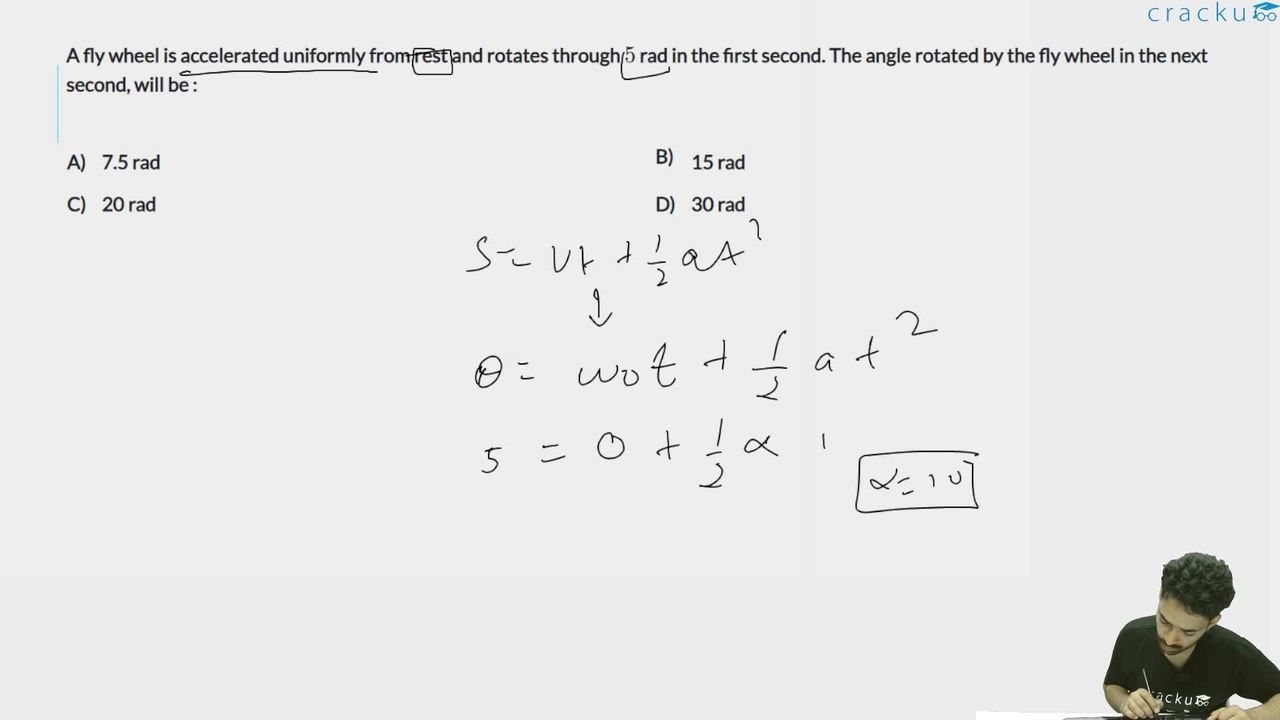
A fly wheel is accelerated uniformly from rest and rotates through $$5$$ rad in the first second. The angle rotated by the fly wheel in the next second, will be :
The flywheel starts from rest and accelerates uniformly with angular acceleration $$\alpha$$. Using the equation for angular displacement with uniform angular acceleration $$\theta = \omega_0 t + \frac{1}{2}\alpha t^2$$ and noting that $$\omega_0 = 0$$, in the first second ($$t = 1$$ s) we have $$5 = \frac{1}{2}\alpha(1)^2$$ so $$\alpha = 10 \text{ rad/s}^2$$. In the first two seconds the total angle is $$\theta_2 = \frac{1}{2}(10)(2)^2 = \frac{1}{2}(10)(4) = 20 \text{ rad}$$, and the angle rotated in the second second is $$\theta_{\text{2nd sec}} = 20 - 5 = 15 \text{ rad}$$.
Using the formula for the angle in the $$n$$th second, $$\theta_n = \omega_0 + \frac{\alpha}{2}(2n - 1)$$, for $$n = 2$$ we get $$\theta_2 = 0 + \frac{10}{2}(2 \times 2 - 1) = 5 \times 3 = 15$$ rad, confirming the result. The correct answer is Option B: 15 rad.
Was this solution helpful?
Click on the Email ☝️ to Watch the Video Solution
Create a FREE account and get:
_1.webp)

Educational materials for JEE preparation

Ask our AI anything

AI can make mistakes. Please verify important information.
AI can make mistakes. Please verify important information.
