Join Our JEE Preparation Group
Prep with like-minded aspirants; Get access to free daily tests and study material.
Sign in
Please select an account to continue using cracku.in
↓ →
Join Our JEE Preparation Group
Prep with like-minded aspirants; Get access to free daily tests and study material.
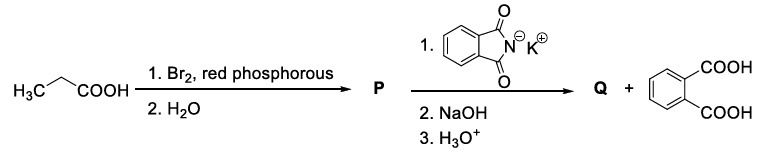
The reaction sequence (given in the paper) finally produces the compound $$\textbf{P}$$ which contains an aldehydic (>CHO) carbonyl group.
Checking Statement A
Sodium borohydride is a mild hydride donor that readily reduces aldehydes to primary alcohols and ketones to secondary alcohols:
$$R{-}CHO \;\xrightarrow[\;]{\;NaBH_4/\,ROH\;}\;R{-}CH_2OH$$
Because $$\textbf{P}$$ is an aldehyde, treatment with $$NaBH_4$$ will indeed give a primary alcohol.
Hence, Statement A is correct.
Checking Statement B
Aldehydes react with concentrated aqueous ammonia to give imines (Schiff bases):
$$R{-}CHO + NH_3 \;\rightleftharpoons\; R{-}CH{=}NH + H_2O$$
Simple acidification of this imine merely regenerates the parent aldehyde; no new compound $$\textbf{Q}$$ is obtained. Formation of a primary amine from an aldehyde would require an additional reducing step (reductive amination), which is not mentioned here.
Therefore, Statement B is false.
Checking Statement C
Statement C presupposes that $$\textbf{Q}$$ is a primary amine (so that diazotisation with $$NaNO_2/HCl$$ would evolve $$N_2$$ gas). As Statement B itself is incorrect, such a primary amine $$\textbf{Q}$$ is never formed in the stated sequence. Consequently, diazotisation and the liberation of $$N_2$$ cannot occur.
Hence, Statement C is false.
Checking Statement D
Acid strength is compared through $$pK_a$$ values. Typical values are
$$pK_a\bigl(CH_3CH_2COOH\bigr)\approx 4.9$$,
$$pK_a\bigl(R{-}CHO\bigr)\approx 17{-}18$$.
The lower the $$pK_a$$, the stronger the acid. A carboxylic acid is therefore far more acidic than an aldehyde or ketone.
So, $$\textbf{P}$$ (an aldehyde) is \emph{less} acidic than $$CH_3CH_2COOH$$.
Thus, Statement D is false.
Only Statement A survives careful scrutiny.
Final Answer: Option A which is: P can be reduced to a primary alcohol using $$NaBH_4$$.
Was this solution helpful?
Create a FREE account and get:
_1.webp)

Educational materials for JEE preparation

Ask our AI anything

AI can make mistakes. Please verify important information.
AI can make mistakes. Please verify important information.