
Join Our JEE Preparation Group
Prep with like-minded aspirants; Get access to free daily tests and study material.
Sign in
Please select an account to continue using cracku.in
↓ →
Join Our JEE Preparation Group
Prep with like-minded aspirants; Get access to free daily tests and study material.
A circular coil of radius 2 cm and 125 turns carries a current of 1 A. The coil is placed in a uniform magnetic field of magnitude 0.4 T. The axis of the coil makes an angle of 30° with the direction of the magnetic field. The torque acting on the coil is $$\alpha \times 10^{-4}$$ N.m. The value of $$\alpha$$ is ______.
($$\pi = 3.14$$)
Correct Answer: 314
The magnitude of the torque on a current-carrying loop in a uniform magnetic field is
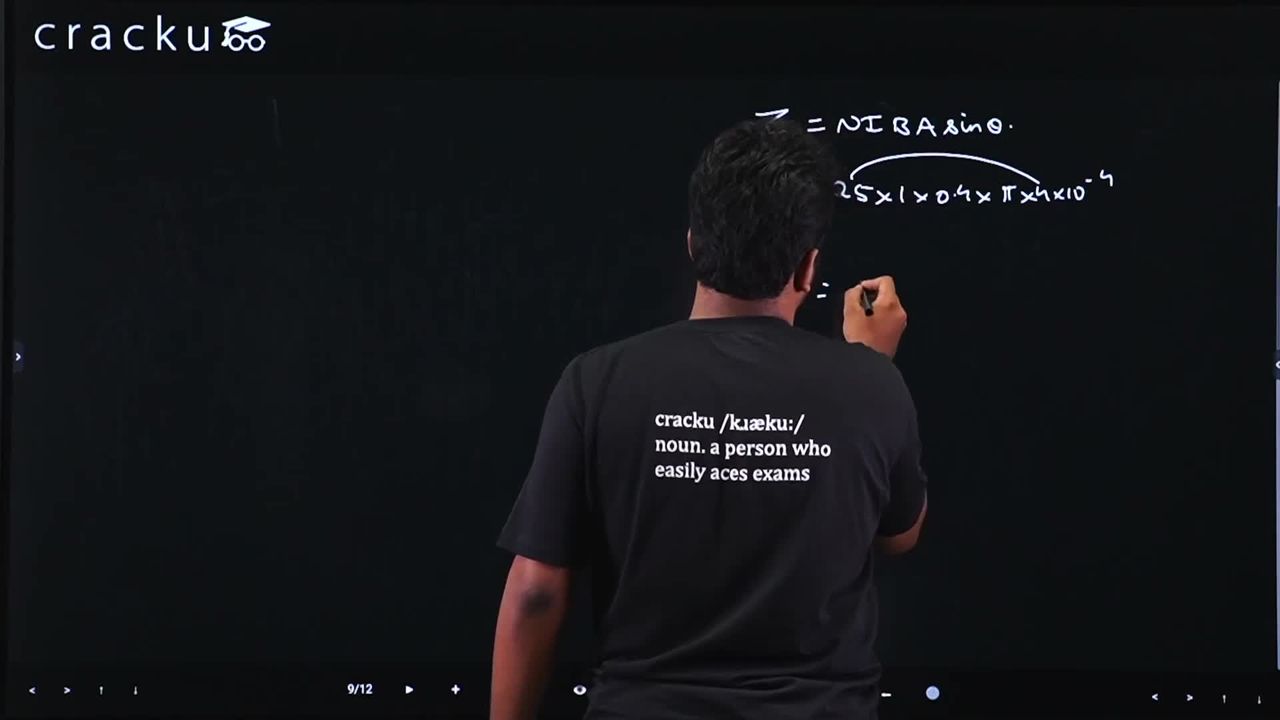
$$\tau = N I A B \sin\theta$$
where
$$N = 125$$ turns, $$I = 1\ \text{A}$$, $$B = 0.4\ \text{T}$$, $$\theta = 30^{\circ}$$ is the angle between the coil’s axis (normal to its plane) and $$\vec B$$, and $$A$$ is the area of one turn.
First find the area of the circular loop:
Radius $$r = 2\ \text{cm} = 0.02\ \text{m}$$
$$A = \pi r^{2} = 3.14 \times (0.02)^{2} = 3.14 \times 0.0004 = 0.001256\ \text{m}^{2}$$
Substitute all values into the torque formula:
$$\tau = 125 \times 1 \times 0.001256 \times 0.4 \times \sin 30^{\circ}$$
Since $$\sin 30^{\circ} = 0.5$$,
$$\tau = 125 \times 0.001256 \times 0.4 \times 0.5$$
$$\tau = 125 \times 0.0005024 \times 0.5$$
$$\tau = 125 \times 0.0002512$$
$$\tau = 0.0314\ \text{N}\cdot\text{m}$$
Express $$0.0314$$ in the form $$\alpha \times 10^{-4}$$:
$$0.0314 = 3.14 \times 10^{-2} = 314 \times 10^{-4}$$
Hence $$\alpha = 314$$.
Final answer: $$\boxed{314}$$
Was this solution helpful?
Click on the Email ☝️ to Watch the Video Solution
Create a FREE account and get:
_1.webp)

Educational materials for JEE preparation

Ask our AI anything

AI can make mistakes. Please verify important information.
AI can make mistakes. Please verify important information.


