
Join Our JEE Preparation Group
Prep with like-minded aspirants; Get access to free daily tests and study material.
Sign in
Please select an account to continue using cracku.in
↓ →
Join Our JEE Preparation Group
Prep with like-minded aspirants; Get access to free daily tests and study material.
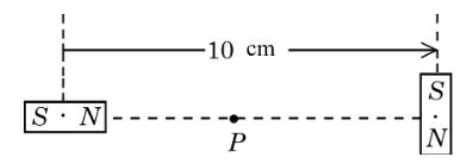
Two identical small bar magnets each of dipole moment $$3\sqrt{5}$$ J/T are placed at a center to center separation of 10 cm, with their axes perpendicular to each other as shown in figure. The value of magnetic field at the point P midway between the magnets is $$\alpha \times 10^{-3}$$ T. The value of $$\alpha$$ is ______
($$\mu_0 = 4\pi \times 10^{-7}$$ Tm/A)
Correct Answer: 12
The centres of the two identical magnets are $$10 \text{ cm}=0.10 \text{ m}$$ apart, so the midpoint $$P$$ is at a distance $$r=\dfrac{0.10}{2}=0.05 \text{ m}$$ from each magnet.
Choose the geometry so that the axis of magnet 1 lies along the line joining the two centres, while the axis of magnet 2 is perpendicular to that line (the axes are given to be perpendicular).
• Therefore, point $$P$$ is on the axial line of magnet 1.
• The same point $$P$$ is on the equatorial line of magnet 2.
For a magnetic dipole of moment $$m$$, the magnitudes of the magnetic field at a point situated at a distance $$r$$ are
Axial line: $$B_{\text{axial}}=\dfrac{\mu_0}{4\pi}\dfrac{2m}{r^{3}}$$
Equatorial line: $$B_{\text{eq}}=\dfrac{\mu_0}{4\pi}\dfrac{m}{r^{3}}$$
The given dipole moment of each magnet is $$m = 3\sqrt{5}\ \text{A·m}^2$$ and $$\dfrac{\mu_0}{4\pi}=10^{-7}\ \text{T·m/A}$$. With $$r = 0.05\ \text{m}$$, we have $$r^{3}=(0.05)^{3}=0.000125 = 1.25\times10^{-4}\ \text{m}^3$$.
Field at $$P$$ due to magnet 1 (axial):
$$B_1 = 10^{-7}\,\dfrac{2m}{r^{3}}
= 10^{-7}\,\dfrac{2(3\sqrt5)}{1.25\times10^{-4}}
= 10^{-7}\,(6\sqrt5)\times8\times10^{3}
= 4.8\sqrt5\times10^{-3}\ \text{T}$$
Numerically, $$4.8\sqrt5 = 4.8(2.236) \approx 10.733$$, so $$B_1 \approx 10.733\times10^{-3}\ \text{T}$$.
Field at $$P$$ due to magnet 2 (equatorial):
$$B_2 = 10^{-7}\,\dfrac{m}{r^{3}}
= 10^{-7}\,\dfrac{3\sqrt5}{1.25\times10^{-4}}
= 10^{-7}\,(3\sqrt5)\times8\times10^{3}
= 2.4\sqrt5\times10^{-3}\ \text{T}$$
Numerically, $$2.4\sqrt5 = 2.4(2.236) \approx 5.366$$, so $$B_2 \approx 5.366\times10^{-3}\ \text{T}$$.
The directions of $$B_1$$ and $$B_2$$ are perpendicular because each field is directed along the axis of its magnet, and the two axes are mutually perpendicular. Therefore, the resultant field magnitude at point $$P$$ is the vector sum:
$$B = \sqrt{B_1^{2}+B_2^{2}}
= \sqrt{(10.733\times10^{-3})^{2} + (5.366\times10^{-3})^{2}}
= 10^{-3}\sqrt{10.733^{2}+5.366^{2}}$$
$$10.733^{2}=115.238,\qquad 5.366^{2}=28.803$$
$$\therefore B = 10^{-3}\sqrt{115.238 + 28.803}
= 10^{-3}\sqrt{144.041}
\approx 10^{-3}\times 12.000
= 12.0\times10^{-3}\ \text{T}$$
Comparing with the required form $$B = \alpha \times 10^{-3}\ \text{T}$$, we get
$$\alpha = 12$$
Answer: 12
Was this solution helpful?
Create a FREE account and get:
_1.webp)

Educational materials for JEE preparation

Ask our AI anything

AI can make mistakes. Please verify important information.
AI can make mistakes. Please verify important information.


