Join WhatsApp Icon JEE WhatsApp Group
Question 48

Consider the above chemical reaction and identify product A:
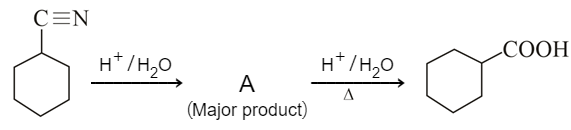
Solution

The given sequence (commonly asked in JEE) first converts an aromatic amine into a diazonium salt and then replaces the diazonium group by a cyano group with the help of cuprous cyanide. Let us analyse each step.

Step 1 - Diazotisation
Aniline, $$C_6H_5NH_2$$, is treated with $$NaNO_2$$ and dil. $$HCl$$ at $$0{-}5^\circ\text{C}$$.
The nitrous acid generated in situ converts the -NH$$_2$$ group into a diazonium group to give benzene diazonium chloride:
$$C_6H_5NH_2 + HNO_2 + HCl \;\longrightarrow\; C_6H_5N_2^+Cl^- + 2H_2O$$

Step 2 - Sandmeyer cyanation
Benzene diazonium chloride is then treated with cuprous cyanide in the presence of potassium cyanide. This is the Sandmeyer reaction, which replaces the diazonium group ($$N_2^+$$) by a cyano group ($$-CN$$):
$$C_6H_5N_2^+Cl^- \;{\xrightarrow[{KCN}]{CuCN}}\; C_6H_5CN + N_2 \uparrow + CuCl$$

Product obtained
The compound formed is benzene nitrile, commonly called benzonitrile $$\big(C_6H_5CN\big)$$.

Therefore, product A is benzonitrile, which corresponds to Option C (Option 3).

Get AI Help

JEE Quant Questions | JEE Quantitative Ability

JEE DILR Questions | LRDI Questions For JEE

JEE Verbal Ability Questions | VARC Questions For JEE

Free JEE Topicwise Questions

JEE Rotational MotionJEE Units & MeasurementsJEE Atomic StructureJEE GravitationJEE Periodic Table & PeriodicityJEE StatisticsJEE Inverse Trigonometric FunctionsJEE Magnetism & Magnetic MaterialsJEE Sequences & SeriesJEE MatricesJEE Alternating CurrentsJEE Carboxylic AcidsJEE Permutations & CombinationsJEE Work, Energy & PowerJEE Electromagnetic InductionJEE Electronic DevicesJEE d and f-Block ElementsJEE Chemical KineticsJEE Heat TransferJEE Three Dimensional GeometryJEE Magnetic Effects of CurrentJEE Hydrocarbons - AromaticJEE Electromagnetic WavesJEE Aldehydes & KetonesJEE Hydrocarbons - AlkanesJEE Applications of DerivativesJEE EquilibriumJEE Indefinite IntegrationJEE Chemical ThermodynamicsJEE ElectrochemistryJEE ProbabilityJEE BiomoleculesJEE Continuity & DifferentiabilityJEE Kinetic Theory of GasesJEE Vector AlgebraJEE Hydrocarbons - AlkynesJEE Differential EquationsJEE Current & ResistanceJEE Straight LinesJEE WavesJEE Redox ReactionsJEE Hydrocarbons - AlkenesJEE DeterminantsJEE SolutionsJEE Ray OpticsJEE Dual Nature of Matter & RadiationJEE Chemical Bonding & Molecular StructureJEE Complex NumbersJEE Sets, Relations & FunctionsJEE Electric Charges & FieldsJEE Laws of MotionJEE Fluid MechanicsJEE Basic Concepts in ChemistryJEE Trigonometric FunctionsJEE LimitsJEE Laws of ThermodynamicsJEE Kinematics - 2D MotionJEE p-Block Elements (Groups 13-18)JEE Simple Harmonic MotionJEE Electric Potential & CapacitanceJEE Coordination CompoundsJEE JEE 2D GeometryJEE CirclesJEE Definite IntegrationJEE EMF & Circuit AnalysisJEE Surface TensionJEE Atoms & NucleiJEE Laboratory Experiments - XIJEE Number SystemJEE Basic Principles of Organic ChemistryJEE Wave OpticsJEE Quadratic EquationsJEE Alcohols, Phenols & EthersJEE Organic Compounds with HalogensJEE DifferentiationJEE Conic SectionsJEE Nitrogen-Containing CompoundsJEE ElasticityJEE Practical Organic ChemistryJEE Kinematics - 1D MotionJEE Purification & CharacterisationJEE Binomial Theorem
Ask AI
