
Join Our JEE Preparation Group
Prep with like-minded aspirants; Get access to free daily tests and study material.
Sign in
Please select an account to continue using cracku.in
↓ →
Join Our JEE Preparation Group
Prep with like-minded aspirants; Get access to free daily tests and study material.
The internal energy of air in a $$4\,\text{m} \times 4\,\text{m} \times 3\,\text{m}$$ sized room at 1 atmospheric pressure will be _________ $$\times 10^6$$ J.
(Consider air as diatomic molecule)
Correct Answer: 12
The room is rectangular with length $$4\,\text{m}$$, breadth $$4\,\text{m}$$ and height $$3\,\text{m}$$.
Hence its volume is
$$V = 4 \times 4 \times 3 = 48\,\text{m}^3$$
The air inside the room may be treated as an ideal gas. For an ideal gas, the equation of state is $$PV = nRT$$ $$-(1)$$
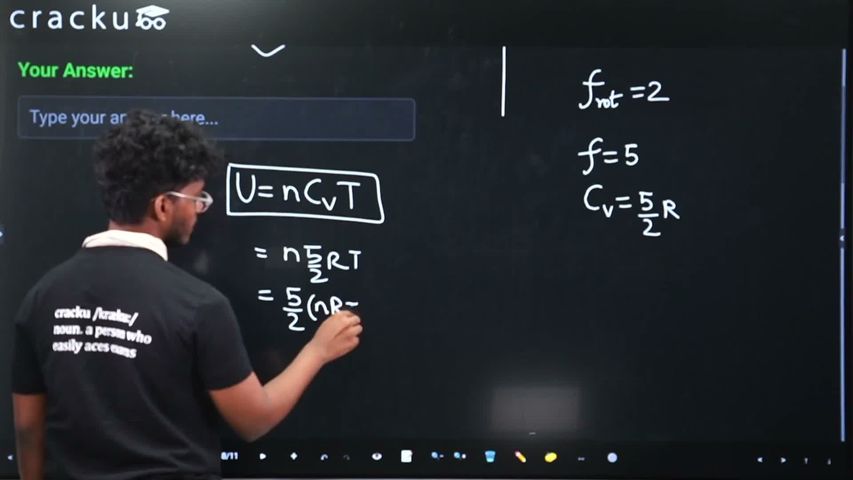
For a diatomic gas (in the ordinary temperature range) the number of degrees of freedom is $$f = 5$$. The molar specific heat at constant volume is therefore $$C_V = \frac{f}{2}R = \frac{5}{2}R$$.
The total internal energy $$U$$ of an ideal gas is given by
$$U = nC_VT$$.
Using $$nRT = PV$$ from $$(1)$$, this becomes
$$U = C_V \left( \frac{PV}{R} \right) = \frac{C_V}{R} \, PV$$.
Substituting $$C_V = \frac{5}{2}R$$: $$U = \frac{5}{2}\,PV$$ $$-(2)$$
The room is at one atmosphere pressure. Taking $$P = 1\,\text{atm} = 1.0 \times 10^5\,\text{Pa}$$ and $$V = 48\,\text{m}^3$$:
$$PV = 1.0 \times 10^5 \times 48 = 4.8 \times 10^6\,\text{J}$$
Using $$(2)$$: $$U = \frac{5}{2} \times 4.8 \times 10^6 = 12.0 \times 10^6\,\text{J}$$
Therefore, the internal energy of the air in the room is $$12 \times 10^6\,\text{J}$$.
Was this solution helpful?
Click on the Email ☝️ to Watch the Video Solution
Create a FREE account and get:
_1.webp)

Educational materials for JEE preparation

Ask our AI anything

AI can make mistakes. Please verify important information.
AI can make mistakes. Please verify important information.


