
Join Our JEE Preparation Group
Prep with like-minded aspirants; Get access to free daily tests and study material.
Sign in
Please select an account to continue using cracku.in
↓ →
Join Our JEE Preparation Group
Prep with like-minded aspirants; Get access to free daily tests and study material.
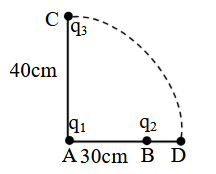
Two charges $$q_1$$ and $$q_2$$ are separated by a distance of 30 cm. A third charge $$q_3$$ initially at 'C' as shown in the figure, is moved along the circular path of radius 40 cm from C to D. If the difference in potential energy due to movement of $$q_3$$ from C to D is given by $$\frac{q_3 K}{4\pi\epsilon_0}$$, the value of K is :
Given:
Thus distance of $$q_3$$ from $$q_1$$ stays constant during motion:
So potential energy due to $$q_1$$ does not change.
Only contribution from $$q_2$$ changes.
Distances from $$q_2$$:
At C:
$$r_{2c}=\sqrt{\ 30^2+40^2}=50cm$$
At D:
Since AD=40 and AB=30,
BD=10 cm
so
$$r_{2D}=10cm$$
Change in potential energy:
$$\Delta U=\frac{1}{4\pi\varepsilon_0}q_3q_2\left(\frac{1}{r_{2D}}-\frac{1}{r_{2C}}\right)$$
Substitute:
$$=\frac{1}{4\pi\varepsilon_0}q_3q_2\left(\frac{1}{10}-\frac{1}{50}\right)=\frac{1}{4\pi\varepsilon_0}q_3q_2\times\ \left(\frac{4}{50}\right)$$
convert 50 cm to m
$$=\frac{1}{4\pi\varepsilon_0}q_3q_2\times\ \left(\frac{4}{0.5}\right)$$
final answer is
$$=\frac{8}{4\pi\varepsilon_0}q_3q_2$$
now comparing it with the given equation
$$K=8q_2$$
Was this solution helpful?
Click on the Email ☝️ to Watch the Video Solution
Create a FREE account and get:
_1.webp)

Educational materials for JEE preparation

Ask our AI anything

AI can make mistakes. Please verify important information.
AI can make mistakes. Please verify important information.
