
Join Our JEE Preparation Group
Prep with like-minded aspirants; Get access to free daily tests and study material.
Sign in
Please select an account to continue using cracku.in
↓ →
Join Our JEE Preparation Group
Prep with like-minded aspirants; Get access to free daily tests and study material.
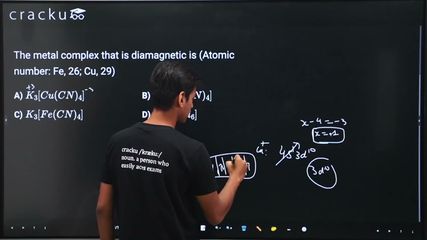
The metal complex that is diamagnetic is (Atomic number: Fe, 26; Cu, 29)
We need to identify the diamagnetic metal complex from the given options.
A complex is diamagnetic if it has no unpaired electrons.
Option A: $$K_3[Cu(CN)_4]$$
Here, $$Cu$$ has a charge of $$+1$$ (since $$3 \times (+1) + x + 4 \times (-1) = 0$$, so $$x = +1$$).
$$Cu^+$$ has electronic configuration: $$[Ar] 3d^{10}$$
With 10 d-electrons, all orbitals are completely filled. Therefore, there are no unpaired electrons.
$$CN^-$$ is a strong field ligand, but regardless of the field strength, $$d^{10}$$ always has zero unpaired electrons.
This complex is diamagnetic.
Option B: $$K_2[Cu(CN)_4]$$
Here, $$Cu$$ has a charge of $$+2$$ (since $$2 \times (+1) + x + 4 \times (-1) = 0$$, so $$x = +2$$).
$$Cu^{2+}$$ has electronic configuration: $$[Ar] 3d^9$$
With 9 d-electrons, there is 1 unpaired electron regardless of the crystal field. This complex is paramagnetic.
Option C: $$K_3[Fe(CN)_4]$$
Here, $$Fe$$ has a charge of $$+1$$ (since $$3 \times (+1) + x + 4 \times (-1) = 0$$, so $$x = +1$$).
$$Fe^+$$ has electronic configuration: $$[Ar] 3d^6 4s^1$$ or $$[Ar] 3d^7$$
With $$CN^-$$ as strong field ligand, $$3d^7$$: $$t_{2g}^6 e_g^1$$ gives 1 unpaired electron. This complex is paramagnetic.
Option D: $$K_4[FeCl_6]$$
Here, $$Fe$$ has a charge of $$+2$$ (since $$4 \times (+1) + x + 6 \times (-1) = 0$$, so $$x = +2$$).
$$Fe^{2+}$$ has electronic configuration: $$[Ar] 3d^6$$
$$Cl^-$$ is a weak field ligand (high spin): $$t_{2g}^4 e_g^2$$ gives 4 unpaired electrons. This complex is paramagnetic.
Therefore, the correct answer is Option A: $$K_3[Cu(CN)_4]$$.
Was this solution helpful?
Click on the Email ☝️ to Watch the Video Solution
Create a FREE account and get:
_1.webp)

Educational materials for JEE preparation

Ask our AI anything

AI can make mistakes. Please verify important information.
AI can make mistakes. Please verify important information.
