
Join Our JEE Preparation Group
Prep with like-minded aspirants; Get access to free daily tests and study material.
Sign in
Please select an account to continue using cracku.in
↓ →
Join Our JEE Preparation Group
Prep with like-minded aspirants; Get access to free daily tests and study material.
The radius of the largest sphere which fits properly at the centre of the edge of a body centred cubic unit cell is: (Edge length is represented by 'a')
First, we recall the geometry of a body-centred cubic (bcc) unit cell. There are atoms at the eight corners $$(0,0,0)$$, $$(1,0,0)$$, $$(0,1,0)$$, $$(0,0,1)$$, $$(1,1,0)$$, $$(1,0,1)$$, $$(0,1,1)$$, $$(1,1,1)$$ and one atom at the body centre $$\left(\dfrac12,\dfrac12,\dfrac12\right)$$, the coordinates being expressed in units of the edge length $$a.$$
In a bcc lattice, the atoms touch each other along the body diagonal. The length of the body diagonal is $$\sqrt{3}\,a,$$ and along this diagonal we have four radii laid end to end (corner atom - body-centre atom - opposite corner atom). Stating this contact condition, we write
$$4\,r_{\text{atom}}=\sqrt{3}\,a,$$
so that the atomic radius is obtained as
$$r_{\text{atom}}=\frac{\sqrt{3}}{4}\,a\;\;(\approx 0.433\,a).$$
We now focus on the void situated at the centre of an edge. Let us take the edge that runs from the corner $$(0,0,0)$$ to the corner $$(1,0,0)$$. Its midpoint, the centre of the edge, has the coordinates
$$\left(\dfrac12,\,0,\,0\right).$$
To find the largest sphere that can be placed at this point without overlapping the neighbouring atoms, we calculate its distance to the nearest atoms.
(i) Distance to the two corner atoms lying on the same edge:
Using the distance formula $$d=\sqrt{(x_2-x_1)^2+(y_2-y_1)^2+(z_2-z_1)^2},$$ the distance from $$\left(\dfrac12,0,0\right)$$ to $$(0,0,0)$$ (and identically to $$(1,0,0)$$) is
$$d_{\text{corner}}=\sqrt{\left(\dfrac12\,a-0\right)^2+0^2+0^2}=\dfrac{a}{2}=0.500\,a.$$
(ii) Distance to the body-centre atom $$\left(\dfrac12,\dfrac12,\dfrac12\right)$$:
$$d_{\text{body}}=\sqrt{\left(\dfrac12\,a-\dfrac12\,a\right)^2+\left(0-\dfrac12\,a\right)^2+\left(0-\dfrac12\,a\right)^2}=\sqrt{0+\left(\dfrac{a}{2}\right)^2+\left(\dfrac{a}{2}\right)^2} =\sqrt{2}\,\dfrac{a}{2}=\dfrac{a}{\sqrt{2}}\;(\approx 0.707\,a).$$
The nearest atoms are therefore the two corner atoms at a distance $$\dfrac{a}{2}.$$ The body-centre atom lies farther away and does not limit the size of the void sphere.
The small sphere we wish to fit will touch these two corner atoms. Hence, its radius is the gap between the centre-to-centre distance and the radius of a corner atom:
$$r_{\text{void}}=d_{\text{corner}}-r_{\text{atom}} =\dfrac{a}{2}-\dfrac{\sqrt{3}}{4}\,a =\left(\dfrac12-\dfrac{\sqrt{3}}{4}\right)a.$$
Evaluating the numerical factor:
$$\dfrac12-\dfrac{\sqrt{3}}{4}=0.500-\dfrac{1.732}{4}=0.500-0.433=0.067.$$
Thus,
$$r_{\text{void}}=0.067\,a.$$
Hence, the correct answer is Option D.
Was this solution helpful?
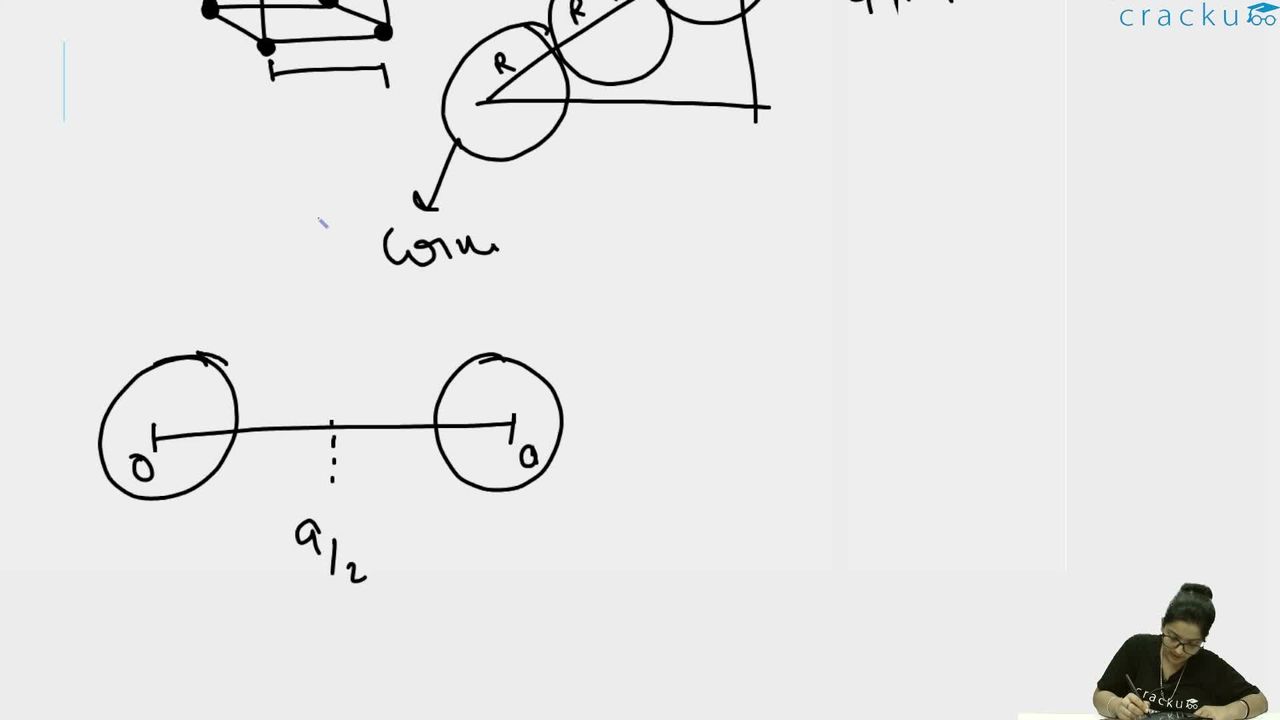
Click on the Email ☝️ to Watch the Video Solution
Create a FREE account and get:
_1.webp)

Educational materials for JEE preparation

Ask our AI anything

AI can make mistakes. Please verify important information.
AI can make mistakes. Please verify important information.


