
Join Our JEE Preparation Group
Prep with like-minded aspirants; Get access to free daily tests and study material.
Sign in
Please select an account to continue using cracku.in
↓ →
Join Our JEE Preparation Group
Prep with like-minded aspirants; Get access to free daily tests and study material.
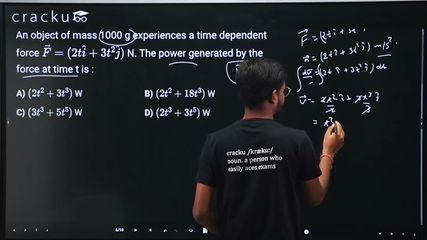
An object of mass 1000 g experiences a time dependent force $$\vec{F} = (2t\hat{i} + 3t^2\hat{j})$$ N. The power generated by the force at time t is :
Mass of the object, $$m = 1000\text{ g} = 1\text{ kg}$$.
Given time-dependent force
$$\vec{F}(t) = 2t\,\hat{i} + 3t^{2}\,\hat{j}\; \text{N}$$
Step 1 : Find acceleration.
Newton’s second law states $$\vec{F} = m\vec{a}$$, hence
$$\vec{a}(t) = \frac{\vec{F}}{m} = 2t\,\hat{i} + 3t^{2}\,\hat{j}$$ $$-(1)$$
Step 2 : Integrate acceleration to obtain velocity.
Assume the object starts from rest at $$t = 0$$, so $$\vec{v}(0) = 0$$.
Component-wise integration of $$(1)$$ gives
$$v_x(t) = \int 2t\,dt = t^{2} + C_x$$
$$v_y(t) = \int 3t^{2}\,dt = t^{3} + C_y$$
Using $$\vec{v}(0)=0$$ implies $$C_x = 0$$ and $$C_y = 0$$.
Therefore
$$\vec{v}(t) = t^{2}\,\hat{i} + t^{3}\,\hat{j}$$ $$-(2)$$
Step 3 : Calculate instantaneous power.
Power delivered by a force is the scalar (dot) product of force and velocity:
$$P(t) = \vec{F}\!\cdot\!\vec{v}$$
Using $$\vec{F}(t)$$ and $$\vec{v}(t)$$ from $$(2)$$:
$$\begin{aligned} P(t) &= (2t\,\hat{i} + 3t^{2}\,\hat{j}) \cdot (t^{2}\,\hat{i} + t^{3}\,\hat{j}) \\ &= 2t \cdot t^{2} + 3t^{2} \cdot t^{3} \\ &= 2t^{3} + 3t^{5} \end{aligned}$$
Step 4 : State the result.
The power generated by the force at time $$t$$ is
$$P(t) = 2t^{3} + 3t^{5}\ \text{W}$$.
Hence, the correct choice is Option D.
Was this solution helpful?
Click on the Email ☝️ to Watch the Video Solution
Create a FREE account and get:
_1.webp)

Educational materials for JEE preparation

Ask our AI anything

AI can make mistakes. Please verify important information.
AI can make mistakes. Please verify important information.
