
Join Our JEE Preparation Group
Prep with like-minded aspirants; Get access to free daily tests and study material.
Sign in
Please select an account to continue using cracku.in
↓ →
Join Our JEE Preparation Group
Prep with like-minded aspirants; Get access to free daily tests and study material.
Two balls with same mass and initial velocity, are projected at different angles in such a way that maximum height reached by first ball is 8 times higher than that of the second ball. $$T_1$$ and $$T_2$$ are the total flying times of first and second ball, respectively, then the ratio of $$T_1$$ and $$T_2$$ is :
Let the common initial speed of both balls be $$u$$ and let the projection angles with the horizontal be $$\theta_1$$ and $$\theta_2$$ for the first and the second ball, respectively.
Step 1 - Write the expression for maximum height.
For a projectile launched with speed $$u$$ at an angle $$\theta$$, the maximum height reached is
$$H=\frac{u^{2}\sin^{2}\theta}{2g}$$
Step 2 - Set up the given height ratio.
Given that the first ball rises eight times higher than the second,
$$\frac{H_1}{H_2}=8$$
Using the formula for $$H$$,
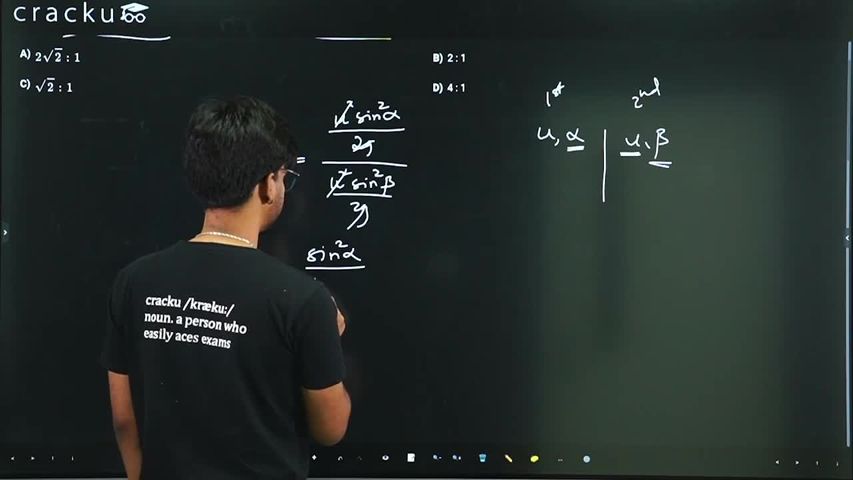
$$\frac{\dfrac{u^{2}\sin^{2}\theta_1}{2g}}{\dfrac{u^{2}\sin^{2}\theta_2}{2g}}=8$$
Simplifying (the factors $$u^{2}$$ and $$2g$$ cancel),
$$\frac{\sin^{2}\theta_1}{\sin^{2}\theta_2}=8$$
Taking square root on both sides,
$$\frac{\sin\theta_1}{\sin\theta_2}=2\sqrt{2}$$ $$-(1)$$
Step 3 - Write the expression for time of flight.
For the same projectile, the total time of flight is
$$T=\frac{2u\sin\theta}{g}$$
Step 4 - Form the required ratio of flight times.
Taking the ratio of times for the two balls,
$$\frac{T_1}{T_2}=\frac{\dfrac{2u\sin\theta_1}{g}}{\dfrac{2u\sin\theta_2}{g}} =\frac{\sin\theta_1}{\sin\theta_2}$$
Using result $$-(1)$$,
$$\frac{T_1}{T_2}=2\sqrt{2}$$
Final ratio.
Hence
$$T_1:T_2 = 2\sqrt{2}:1$$
So the correct choice is Option A.
Was this solution helpful?
Click on the Email ☝️ to Watch the Video Solution
Create a FREE account and get:
_1.webp)

Educational materials for JEE preparation

Ask our AI anything

AI can make mistakes. Please verify important information.
AI can make mistakes. Please verify important information.
