
Join Our JEE Preparation Group
Prep with like-minded aspirants; Get access to free daily tests and study material.
Sign in
Please select an account to continue using cracku.in
↓ →
Join Our JEE Preparation Group
Prep with like-minded aspirants; Get access to free daily tests and study material.
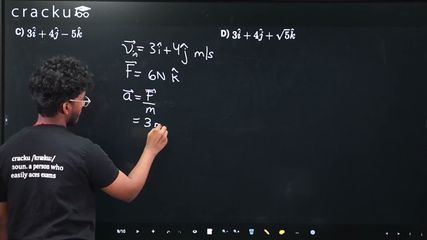
A body of mass 2 kg moving with velocity of $$\vec{v}_{in} = 3\hat{i} + 4\hat{j}$$ ms$$^{-1}$$ enters into a constant force field of 6N directed along positive z-axis. If the body remains in the field for a period of $$\frac{5}{3}$$ seconds, then velocity of the body when it emerges from force field is
Initial velocity of the body is given as $$\vec v_{in}=3\hat i+4\hat j$$ ms$$^{-1}$$, so
$$u_x = 3$$ ms$$^{-1},\; u_y = 4$$ ms$$^{-1},\; u_z = 0$$ ms$$^{-1}$$.
The constant force acting on the mass is $$\vec F = 6\hat k$$ N (along +z-axis).
Using Newton’s second law, $$\vec F = m\vec a \Rightarrow \vec a = \frac{\vec F}{m}$$.
The mass of the body is $$m = 2$$ kg, therefore
$$\vec a = \frac{6\hat k}{2} = 3\hat k$$ ms$$^{-2}$$.
The body stays in this field for $$t = \frac{5}{3}$$ s. The kinematics relation $$\vec v = \vec u + \vec a t$$ gives the final velocity:
Along x-axis: $$v_x = u_x + a_x t = 3 + 0 \times t = 3$$ ms$$^{-1}$$ (no force in x).
Along y-axis: $$v_y = u_y + a_y t = 4 + 0 \times t = 4$$ ms$$^{-1}$$ (no force in y).
Along z-axis: $$v_z = u_z + a_z t = 0 + 3 \times \frac{5}{3} = 5$$ ms$$^{-1}$$.
Hence the velocity vector when the body emerges is
$$\vec v_{out}=3\hat i + 4\hat j + 5\hat k$$ ms$$^{-1}$$.
Therefore, the correct option is Option B.
Click on the Email ☝️ to Watch the Video Solution
Create a FREE account and get:
_1.webp)

Educational materials for JEE preparation

Ask our AI anything

AI can make mistakes. Please verify important information.
AI can make mistakes. Please verify important information.


