
Join Our JEE Preparation Group
Prep with like-minded aspirants; Get access to free daily tests and study material.
Sign in
Please select an account to continue using cracku.in
↓ →
Join Our JEE Preparation Group
Prep with like-minded aspirants; Get access to free daily tests and study material.
Match List - I with List - II.
| List-I | List-II |
|---|---|
| A Concentration of gold ore | I Aniline |
| B Leaching of alumina | II NaOH |
| C Froth stabiliser | III $$SO_2$$ |
| D Blister copper | IV NaCN |
Choose the correct answer from the options given below
Let us match each item in List-I with the correct item in List-II.
A. Concentration of gold ore → IV (NaCN)
Gold ore is concentrated by the cyanide leaching process (MacArthur-Forrest process). Gold reacts with dilute NaCN solution in the presence of air to form a soluble gold cyanide complex:
$$4Au + 8NaCN + 2H_2O + O_2 \rightarrow 4Na[Au(CN)_2] + 4NaOH$$
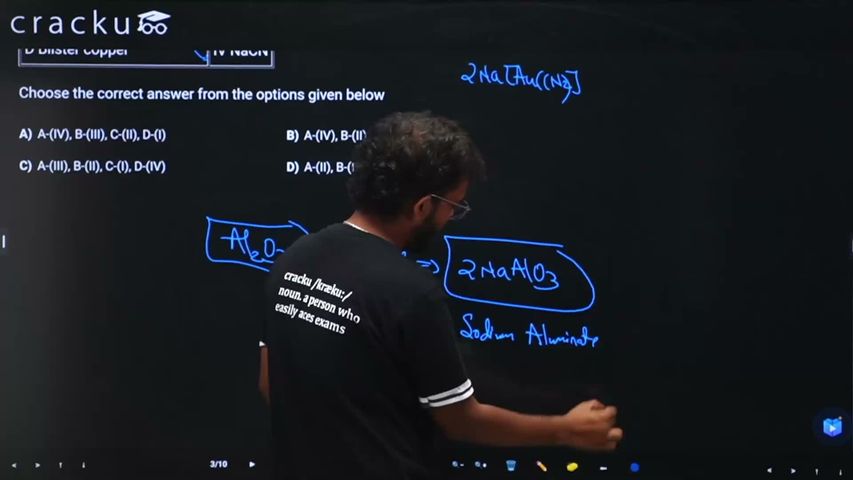
B. Leaching of alumina → II (NaOH)
In Bayer's process, bauxite ore (containing $$Al_2O_3$$) is leached with concentrated NaOH solution. Alumina dissolves as sodium aluminate:
$$Al_2O_3 + 2NaOH \rightarrow 2NaAlO_2 + H_2O$$
C. Froth stabiliser → I (Aniline)
In the froth floatation process, froth stabilisers like aniline or cresol are added to stabilise the froth so that the ore particles can be collected effectively.
D. Blister copper → III ($$SO_2$$)
Blister copper gets its name from the blisters formed on its surface due to the evolution of $$SO_2$$ gas during the solidification of molten copper. The $$SO_2$$ is produced during the bessemerisation process:
$$Cu_2S + 3O_2 \rightarrow 2Cu_2O + 2SO_2$$
$$2Cu_2O + Cu_2S \rightarrow 6Cu + SO_2$$
The correct matching is: A-(IV), B-(II), C-(I), D-(III)
Hence, the correct answer is Option B.
Was this solution helpful?
Click on the Email ☝️ to Watch the Video Solution
Create a FREE account and get:
_1.webp)

Educational materials for JEE preparation

Ask our AI anything

AI can make mistakes. Please verify important information.
AI can make mistakes. Please verify important information.
