
Join Our JEE Preparation Group
Prep with like-minded aspirants; Get access to free daily tests and study material.
Sign in
Please select an account to continue using cracku.in
↓ →
Join Our JEE Preparation Group
Prep with like-minded aspirants; Get access to free daily tests and study material.
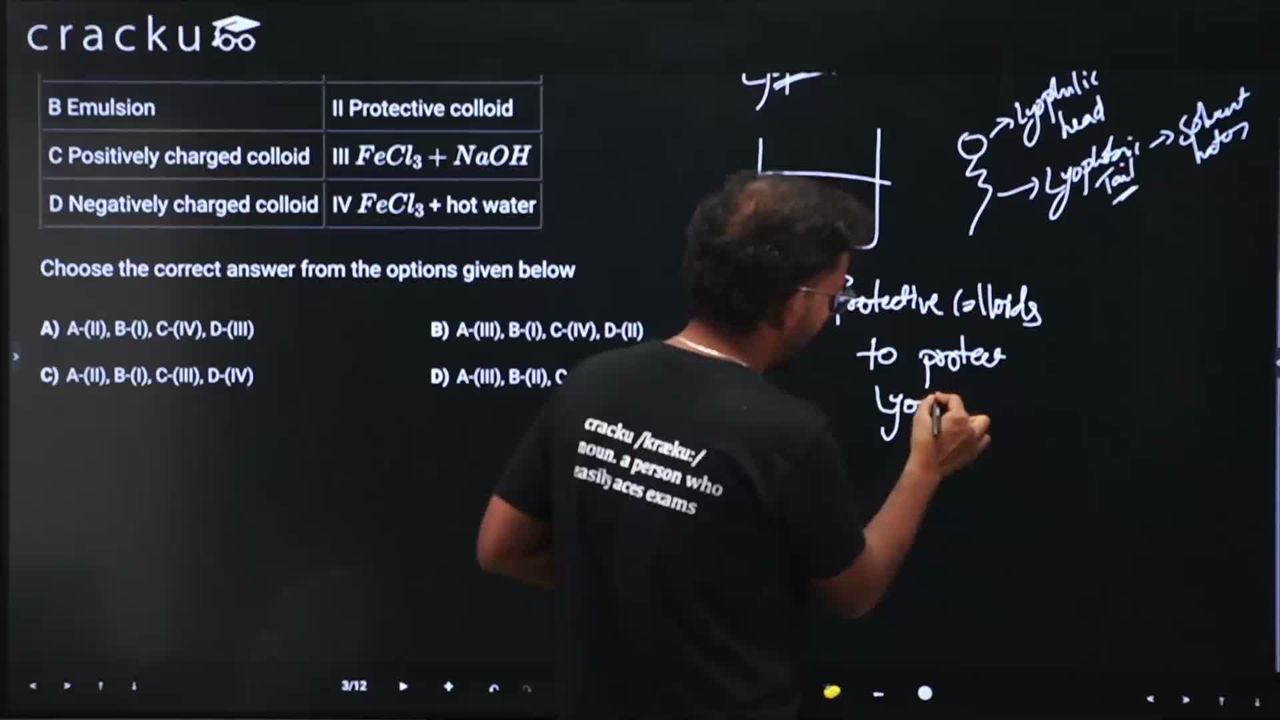
Match List - I with List - II.
| List-I | List-II |
|---|---|
| A Lyophilic colloid | I Liquid-liquid colloid |
| B Emulsion | II Protective colloid |
| C Positively charged colloid | III $$FeCl_3 + NaOH$$ |
| D Negatively charged colloid | IV $$FeCl_3$$ + hot water |
Choose the correct answer from the options given below
Let us match each item in List-I with the correct item in List-II.
A. Lyophilic colloid → II (Protective colloid)
Lyophilic colloids (solvent-loving) are stable colloids that can protect lyophobic colloids from coagulation. They are also called protective colloids. Examples include gelatin, starch, and gum arabic.
B. Emulsion → I (Liquid-liquid colloid)
An emulsion is a colloidal system where both the dispersed phase and the dispersion medium are liquids. For example, milk is an emulsion of fat droplets in water. Hence, emulsion is a liquid-liquid colloid.
C. Positively charged colloid → IV ($$FeCl_3$$ + hot water)
When $$FeCl_3$$ is added to hot water, it hydrolyzes to form a colloidal solution of $$Fe(OH)_3$$ which is positively charged. The $$Fe^{3+}$$ ions are preferentially adsorbed on the $$Fe(OH)_3$$ particles, giving them a positive charge.
D. Negatively charged colloid → III ($$FeCl_3 + NaOH$$)
When $$FeCl_3$$ is mixed with excess $$NaOH$$, the $$Fe(OH)_3$$ sol formed adsorbs $$OH^-$$ ions from the excess NaOH, making the colloidal particles negatively charged.
The correct matching is: A-(II), B-(I), C-(IV), D-(III)
Hence, the correct answer is Option A.
Was this solution helpful?
Click on the Email ☝️ to Watch the Video Solution
Create a FREE account and get:
_1.webp)

Educational materials for JEE preparation

Ask our AI anything

AI can make mistakes. Please verify important information.
AI can make mistakes. Please verify important information.
