
Join Our JEE Preparation Group
Prep with like-minded aspirants; Get access to free daily tests and study material.
Sign in
Please select an account to continue using cracku.in
↓ →
Join Our JEE Preparation Group
Prep with like-minded aspirants; Get access to free daily tests and study material.
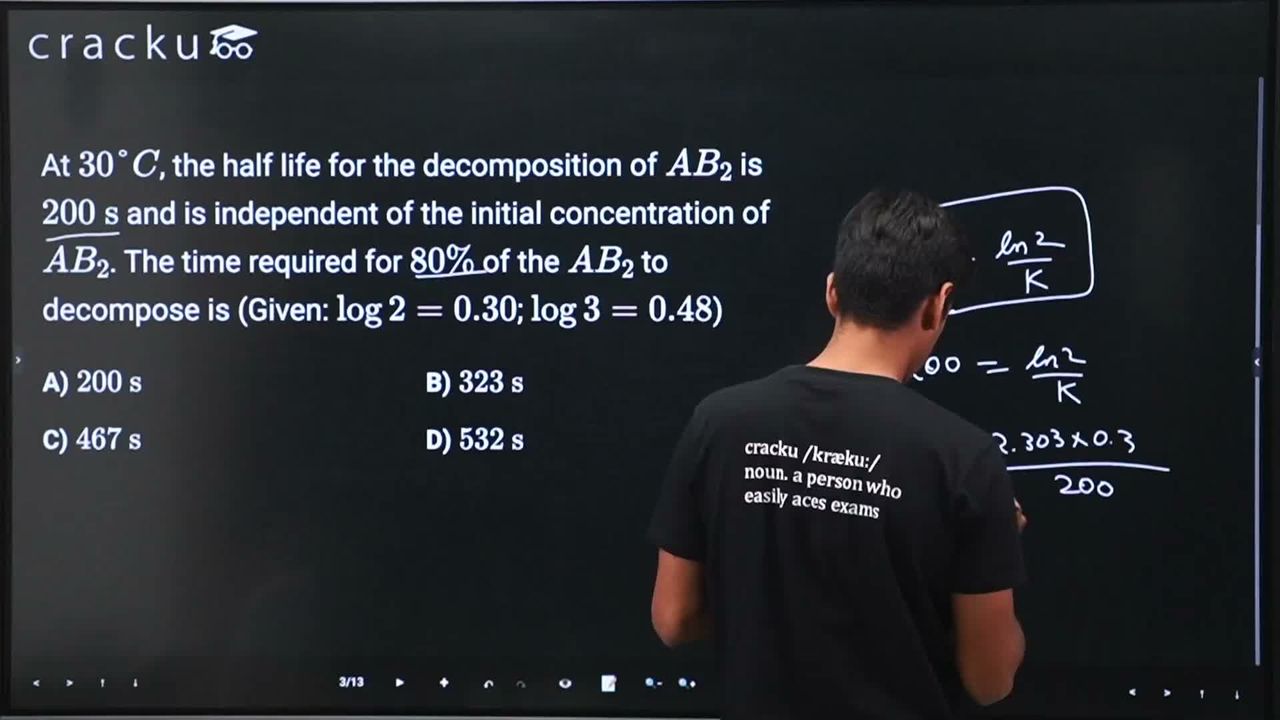
At $$30°C$$, the half life for the decomposition of $$AB_2$$ is $$200 \text{ s}$$ and is independent of the initial concentration of $$AB_2$$. The time required for $$80\%$$ of the $$AB_2$$ to decompose is (Given: $$\log 2 = 0.30$$; $$\log 3 = 0.48$$)
We are given that the half-life of decomposition of $$AB_2$$ is 200 s and is independent of the initial concentration. We need to find the time for 80% decomposition.
Since the half-life is independent of the initial concentration, this is a first-order reaction.
For a first-order reaction:
$$t_{1/2} = \frac{0.693}{k}$$
$$k = \frac{0.693}{200} = \frac{0.693}{200} \text{ s}^{-1}$$
For 80% decomposition, only 20% of the initial amount remains. So if the initial concentration is $$[A]_0$$, the remaining concentration is $$0.2[A]_0$$.
The first-order rate equation is:
$$t = \frac{2.303}{k} \log \frac{[A]_0}{[A]}$$
$$t = \frac{2.303}{k} \log \frac{[A]_0}{0.2[A]_0}$$
$$t = \frac{2.303}{k} \log 5$$
$$\log 5 = \log \frac{10}{2} = \log 10 - \log 2 = 1 - 0.30 = 0.70$$
$$t = \frac{2.303 \times 0.70}{k} = \frac{2.303 \times 0.70 \times 200}{0.693}$$
$$t = \frac{2.303 \times 0.70 \times 200}{0.693}$$
Numerator: $$2.303 \times 0.70 = 1.6121$$
$$1.6121 \times 200 = 322.42$$
$$t = \frac{322.42}{0.693} = 465.3 \text{ s} \approx 467 \text{ s}$$
Therefore, the correct answer is Option C: 467 s.
Was this solution helpful?
Click on the Email ☝️ to Watch the Video Solution
Create a FREE account and get:
_1.webp)

Educational materials for JEE preparation

Ask our AI anything

AI can make mistakes. Please verify important information.
AI can make mistakes. Please verify important information.
