
Join Our JEE Preparation Group
Prep with like-minded aspirants; Get access to free daily tests and study material.
Sign in
Please select an account to continue using cracku.in
↓ →
Join Our JEE Preparation Group
Prep with like-minded aspirants; Get access to free daily tests and study material.
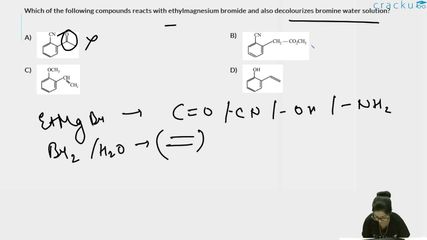
Which of the following compounds reacts with ethylmagnesium bromide and also decolourizes bromine water solution?
We have to select that compound which fulfils both of the following conditions:
(i) it must react with the Grignard reagent $$\mathrm{C_2H_5MgBr}$$ (ethyl-magnesium bromide), and
(ii) it must decolourize an aqueous bromine solution (bromine water).
First we recall the general behaviour of a Grignard reagent. Ethyl-magnesium bromide is represented as $$\mathrm{C_2H_5^- \,\,Mg^{2+}Br^-}$$, so the carbon attached to magnesium behaves as a very strong base and nucleophile. Therefore, any compound containing an acidic hydrogen (-OH, -NH, -SH, etc.) instantly reacts with a Grignard reagent according to
$$\mathrm{R{-}H \;+\; C_2H_5MgBr \;\longrightarrow\; R^-\,MgBr^+ \;+\; C_2H_6}\,,$$
where $$\mathrm{R{-}H}$$ denotes the acidic compound and the ethyl group becomes $$\mathrm{C_2H_6}$$ (ethane).
Now we recall the test with bromine water. Aqueous $$\mathrm{Br_2}$$ is ruddy brown; it gets decolourised by
• compounds containing an electron-rich double bond $$\mathrm{C=C}$$ (alkenes, enols), and
• compounds whose aromatic ring is strongly activated, for example phenol, which undergoes electrophilic bromination to give 2,4,6-tribromophenol:
$$\mathrm{C_6H_5OH + 3\,Br_2(aq) \;\longrightarrow\; C_6H_2Br_3OH + 3\,HBr}$$
and the reddish colour of $$\mathrm{Br_2}$$ disappears.
Let us check each option qualitatively:
• Option A carries a $$\mathrm{C\equiv N}$$ and a carbonyl oxygen. It does react with a Grignard reagent (nitrile and carbonyl are both reactive), but neither group can decolourise bromine water because there is no strongly activated aromatic ring nor an alkenic double bond able to add bromine in water. So Option A fails condition (ii).
• Option B contains a nitrile $$\mathrm{-C\!\equiv N}$$ and an ester $$\mathrm{-CO_2CH_3}$$. Again, it reacts with the Grignard reagent, but an ester/nitrile does not affect bromine water. Hence Option B also fails condition (ii).
• Option C shows an ether $$\mathrm{-OCH_3}$$ and a carbon-carbon double bond $$\mathrm{CH=CH_2}$$. The double bond definitely decolourises bromine water, satisfying condition (ii). However, simple alkenes do not possess an acidic hydrogen and therefore do not react with ethyl-magnesium bromide. Thus Option C fails condition (i).
• Option D bears a hydroxyl group $$\mathrm{-OH}$$, and from the context of typical JEE questions this -OH is almost always on an aromatic ring (phenol). We analyse it quantitatively:
Reaction with Grignard reagent
Applying the general acid-base formula written earlier, we let $$\mathrm{ArOH}$$ represent phenol:
$$\mathrm{ArOH + C_2H_5MgBr \;\longrightarrow\; ArO^-\,MgBr^+ + C_2H_6}.$$
The hydrogen of the hydroxyl group is sufficiently acidic (pKₐ ≈ 10), so it is abstracted, giving magnesium phenoxide and ethane gas. Condition (i) is thus satisfied.
Decolourisation of bromine water
The aromatic ring of phenol is strongly activated by the $$\mathrm{-OH}$$ group. When bromine water is added, electrophilic substitution occurs at the ortho and para positions:
$$\mathrm{ArOH + 3\,Br_2 (aq) \;\longrightarrow\; Ar(Br)_3OH + 3\,HBr},$$
and the brown colour of $$\mathrm{Br_2}$$ vanishes. Hence condition (ii) is also satisfied.
Therefore only the compound possessing the hydroxyl (phenolic) group fulfils both required properties.
Hence, the correct answer is Option 4.
Was this solution helpful?
Click on the Email ☝️ to Watch the Video Solution
Create a FREE account and get:
_1.webp)

Educational materials for JEE preparation

Ask our AI anything

AI can make mistakes. Please verify important information.
AI can make mistakes. Please verify important information.


