
Join Our JEE Preparation Group
Prep with like-minded aspirants; Get access to free daily tests and study material.
Sign in
Please select an account to continue using cracku.in
↓ →
Join Our JEE Preparation Group
Prep with like-minded aspirants; Get access to free daily tests and study material.
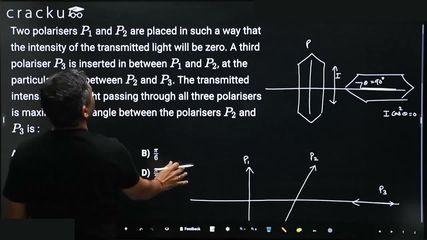
Two polarisers $$P_1$$ and $$P_2$$ are placed in such a way that the intensity of the transmitted light will be zero. A third polariser $$P_3$$ is inserted in between $$P_1$$ and $$P_2$$, at the particular angle between $$P_2$$ and $$P_3$$. The transmitted intensity of the light passing through all three polarisers is maximum. The angle between the polarisers $$P_2$$ and $$P_3$$ is :
Let the incident beam on $$P_1$$ be un-polarised with intensity $$I_0$$.
Step 1 (Polariser $$P_1$$)
An ideal polariser transmits one-half of the incident intensity. Hence, after $$P_1$$ the light is plane-polarised with
$$I_1 = \frac{I_0}{2}$$ $$-(1)$$
Step 2 (Geometry of the three axes)
$$P_1$$ and $$P_2$$ are crossed, so the angle between their transmission axes is $$90^\circ$$ (i.e. $$\frac{\pi}{2}$$).
Insert $$P_3$$ between them such that the angle between $$P_2$$ and $$P_3$$ is $$\theta$$.
Therefore, the angle between $$P_1$$ and $$P_3$$ is $$\frac{\pi}{2} - \theta$$.
Step 3 (Intensity after $$P_3$$)
Using Malus’ law (transmitted intensity $$I = I_{\text{in}}\cos^2\alpha$$, where $$\alpha$$ is the angle between the light’s polarisation and the polariser’s axis), we have
$$I_2 = I_1 \cos^2\!\left(\frac{\pi}{2}-\theta\right) = \frac{I_0}{2}\,\sin^2\theta$$ $$-(2)$$
Step 4 (Intensity after $$P_2$$)
Now the light emerging from $$P_3$$ makes an angle $$\theta$$ with the axis of $$P_2$$, so again applying Malus’ law,
$$I_3 = I_2 \cos^2\theta = \frac{I_0}{2}\,\sin^2\theta\,\cos^2\theta$$
Combine the trigonometric factors:
$$\sin^2\theta\,\cos^2\theta = \left(\sin\theta\cos\theta\right)^2 = \left(\tfrac{1}{2}\sin2\theta\right)^2 = \frac{1}{4}\sin^2 2\theta$$
Hence
$$I_3 = \frac{I_0}{2}\times\frac{1}{4}\sin^2 2\theta = \frac{I_0}{8}\,\sin^2 2\theta$$ $$-(3)$$
Step 5 (Maximising the transmitted intensity)
The factor $$\sin^2 2\theta$$ attains its maximum value of $$1$$ when
$$2\theta = \frac{\pi}{2},\,\frac{3\pi}{2},\ldots$$ Taking the first positive solution inside $$0 \lt \theta \lt \frac{\pi}{2}$$ gives
$$\theta = \frac{\pi}{4}$$.
Conclusion
For maximum transmitted intensity through the three polarisers, the angle between $$P_2$$ and $$P_3$$ must be $$\frac{\pi}{4}$$.
Therefore, Option A is correct.
Was this solution helpful?
Click on the Email ☝️ to Watch the Video Solution
Create a FREE account and get:
_1.webp)

Educational materials for JEE preparation

Ask our AI anything

AI can make mistakes. Please verify important information.
AI can make mistakes. Please verify important information.
