
Join Our JEE Preparation Group
Prep with like-minded aspirants; Get access to free daily tests and study material.
Sign in
Please select an account to continue using cracku.in
↓ →
Join Our JEE Preparation Group
Prep with like-minded aspirants; Get access to free daily tests and study material.
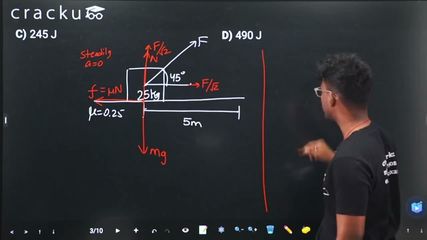
A block of mass 25 kg is pulled along a horizontal surface by a force at an angle 45 degrees with the horizontal such that it moves steadily. The friction coefficient between the block and the surface is 0.25. The work done by force for a displacement of 5 m of the block is : (Take g=$$9.8m/s^2$$)
The forces on the block are:
• weight $$mg$$ downward
• normal reaction $$N$$ upward
• applied force $$\mathbf{F}$$ making $$45^{\circ}$$ with the horizontal
• kinetic friction $$f_k$$ opposite to the motion along the surface.
Resolve the applied force:
Horizontal component $$F_x = F\cos 45^{\circ} = \dfrac{F}{\sqrt{2}}$$
Vertical component $$F_y = F\sin 45^{\circ} = \dfrac{F}{\sqrt{2}}$$
Vertical equilibrium (no vertical motion):
$$N + F_y = mg$$
so
$$N = mg - \frac{F}{\sqrt{2}} \quad -(1)$$
Friction coefficient is $$\mu = 0.25$$, hence
$$f_k = \mu N = \mu\left( mg - \frac{F}{\sqrt{2}} \right) \quad -(2)$$
The block is pulled steadily (horizontal acceleration zero). Therefore
horizontal forces balance:
$$F_x = f_k$$
$$\frac{F}{\sqrt{2}} = \mu\left( mg - \frac{F}{\sqrt{2}} \right) \quad -(3)$$
Solve equation $$-(3)$$ for $$F$$:
$$\frac{F}{\sqrt{2}} + \mu\frac{F}{\sqrt{2}} = \mu mg$$
$$F(1+\mu)\frac{1}{\sqrt{2}} = \mu mg$$
$$F = \frac{\mu mg\sqrt{2}}{1+\mu}$$
Insert the data $$m = 25\ \text{kg},\; g = 9.8\ \text{m s}^{-2},\; \mu = 0.25$$:
$$F = \frac{0.25 \times 25 \times 9.8 \times 1.414}{1 + 0.25}$$
$$F \approx \frac{86.6}{1.25} \approx 69.3\ \text{N}$$
Horizontal component of the applied force:
$$F_x = \frac{F}{\sqrt{2}} \approx \frac{69.3}{1.414} \approx 49.0\ \text{N}$$
Work done by the external force over the displacement $$s = 5\ \text{m}$$:
$$W = F_x\,s = 49.0 \times 5 \approx 245\ \text{J}$$
Therefore, the work done by the external force is $$245\ \text{J}$$.
Correct option: Option C
Was this solution helpful?
Click on the Email ☝️ to Watch the Video Solution
Create a FREE account and get:
_1.webp)

Educational materials for JEE preparation

Ask our AI anything

AI can make mistakes. Please verify important information.
AI can make mistakes. Please verify important information.
