
Join Our JEE Preparation Group
Prep with like-minded aspirants; Get access to free daily tests and study material.
Sign in
Please select an account to continue using cracku.in
↓ →
Join Our JEE Preparation Group
Prep with like-minded aspirants; Get access to free daily tests and study material.
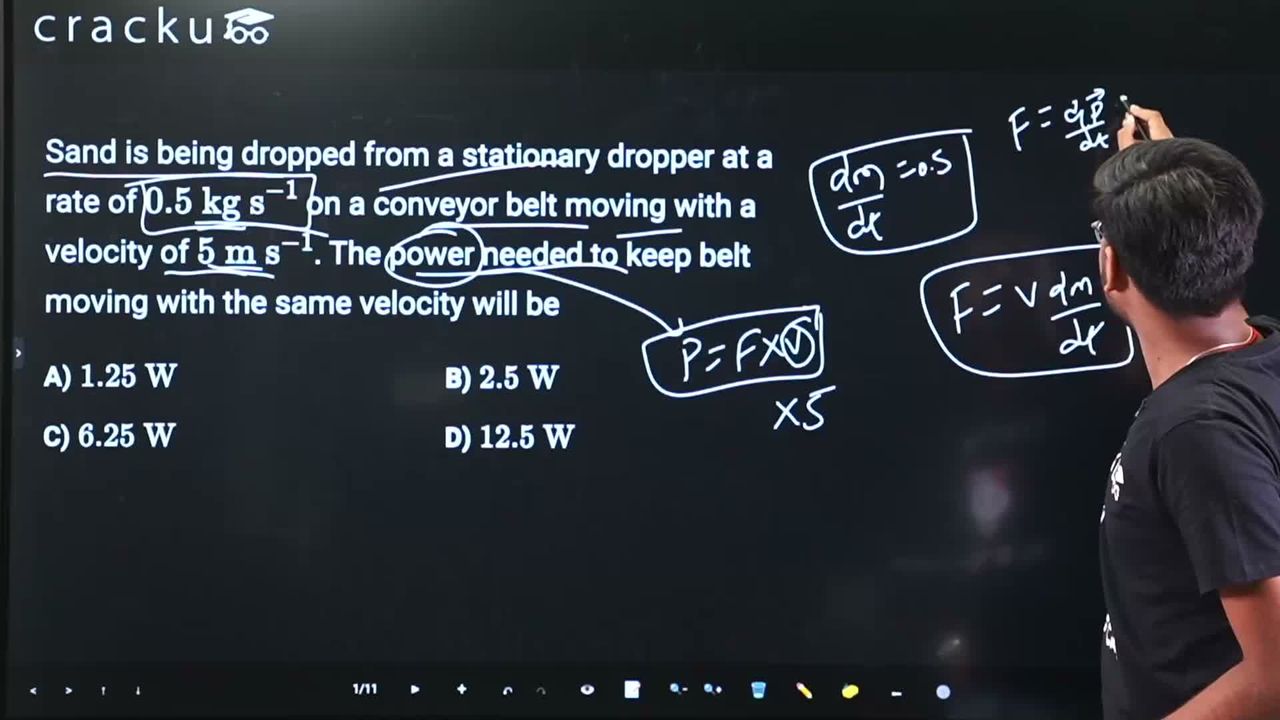
Sand is being dropped from a stationary dropper at a rate of $$0.5 \text{ kg s}^{-1}$$ on a conveyor belt moving with a velocity of $$5 \text{ m s}^{-1}$$. The power needed to keep belt moving with the same velocity will be
Sand is dropped from a stationary dropper at a rate of $$\frac{dm}{dt} = 0.5 \text{ kg s}^{-1}$$ onto a conveyor belt moving with velocity $$v = 5 \text{ m/s}$$. When the sand falls on the belt it has zero horizontal velocity, so the belt must accelerate each sand particle from 0 to $$v = 5$$ m/s, requiring a continuous force to maintain the belt speed against the momentum gained by the falling sand.
The rate of change of momentum of the sand gives the force required: $$F = v \cdot \frac{dm}{dt}$$ because each unit of sand gains momentum $$v \cdot dm$$ in time $$dt$$. Substituting the values, $$F = 5 \times 0.5 = 2.5 \text{ N}.$$
The power supplied by the motor is the force multiplied by the belt’s velocity: $$P = F \times v = v^2 \cdot \frac{dm}{dt}$$ so $$P = (5)^2 \times 0.5 = 25 \times 0.5 = 12.5 \text{ W}.$$
Note: The kinetic energy gained by the sand per second is $$\tfrac{1}{2}\,\frac{dm}{dt}\,v^2 = \tfrac{1}{2} \times 0.5 \times 25 = 6.25\text{ W},$$ and the remaining $$12.5 - 6.25 = 6.25\text{ W}$$ is dissipated as heat due to friction between the sand and the belt. The total power supplied by the motor must therefore be $$12.5\text{ W}$$ to account for both the kinetic energy gain and the frictional losses.
The correct answer is Option D: $$12.5 \text{ W}$$.
Was this solution helpful?
Click on the Email ☝️ to Watch the Video Solution
Create a FREE account and get:
_1.webp)

Educational materials for JEE preparation

Ask our AI anything

AI can make mistakes. Please verify important information.
AI can make mistakes. Please verify important information.
