
Join Our JEE Preparation Group
Prep with like-minded aspirants; Get access to free daily tests and study material.
Sign in
Please select an account to continue using cracku.in
↓ →
Join Our JEE Preparation Group
Prep with like-minded aspirants; Get access to free daily tests and study material.
Match List-I with List-II
| List-I | List-II |
|---|---|
| (A) M.I. of solid sphere of radius R about any tangent. | (I) $$\frac{5}{3}MR^2$$ |
| (B) M.I. of hollow sphere of radius R about any tangent. | (II) $$\frac{7}{5}MR^2$$ |
| (C) M.I. of circular ring of radius R about its diameter. | (III) $$\frac{1}{4}MR^2$$ |
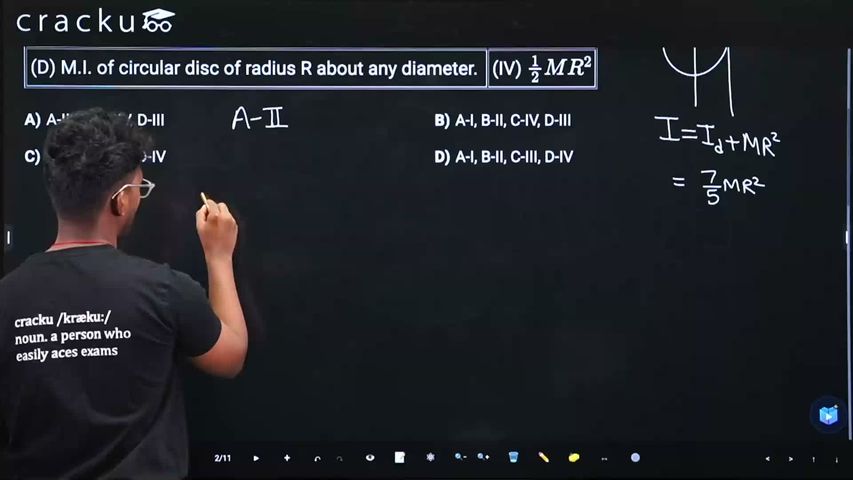
| (D) M.I. of circular disc of radius R about any diameter. | (IV) $$\frac{1}{2}MR^2$$ |
We need to match the moment of inertia expressions using standard formulas and the parallel axis theorem.
(A) M.I. of solid sphere about a tangent:
M.I. about the center = $$\frac{2}{5}MR^2$$
By parallel axis theorem (shifting by distance $$R$$):
$$I = \frac{2}{5}MR^2 + MR^2 = \frac{2 + 5}{5}MR^2 = \frac{7}{5}MR^2$$
This matches (II).
(B) M.I. of hollow sphere about a tangent:
M.I. about the center = $$\frac{2}{3}MR^2$$
By parallel axis theorem:
$$I = \frac{2}{3}MR^2 + MR^2 = \frac{2 + 3}{3}MR^2 = \frac{5}{3}MR^2$$
This matches (I).
(C) M.I. of circular ring about its diameter:
By perpendicular axis theorem: $$I_z = I_x + I_y$$
For a ring, $$I_z = MR^2$$ (about axis through center, perpendicular to plane)
By symmetry, $$I_x = I_y$$, so: $$I_x = \frac{MR^2}{2} = \frac{1}{2}MR^2$$
This matches (IV).
(D) M.I. of circular disc about any diameter:
M.I. about axis perpendicular to disc through center = $$\frac{1}{2}MR^2$$
By perpendicular axis theorem and symmetry:
$$I_{\text{diameter}} = \frac{1}{2} \times \frac{1}{2}MR^2 = \frac{1}{4}MR^2$$
This matches (III).
The matching is: A-II, B-I, C-IV, D-III
The correct answer is Option A.
Was this solution helpful?
Click on the Email ☝️ to Watch the Video Solution
Create a FREE account and get:
_1.webp)

Educational materials for JEE preparation

Ask our AI anything

AI can make mistakes. Please verify important information.
AI can make mistakes. Please verify important information.
