
Join Our JEE Preparation Group
Prep with like-minded aspirants; Get access to free daily tests and study material.
Sign in
Please select an account to continue using cracku.in
↓ →
Join Our JEE Preparation Group
Prep with like-minded aspirants; Get access to free daily tests and study material.
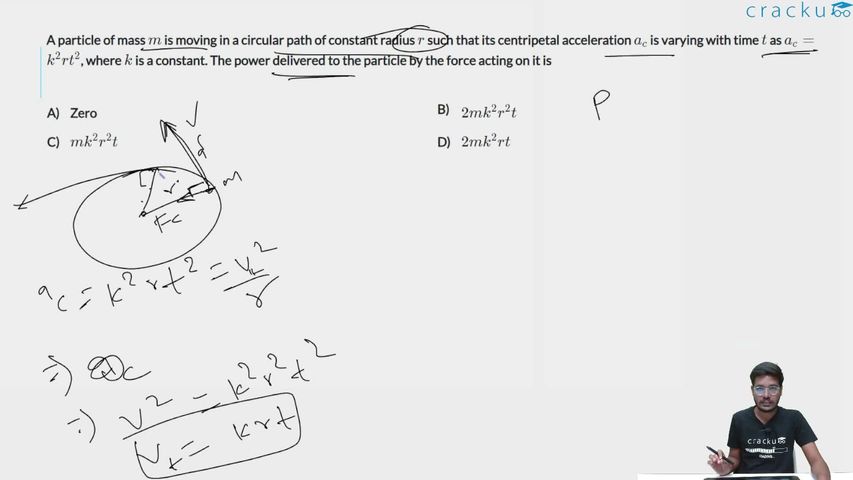
A particle of mass $$m$$ is moving in a circular path of constant radius $$r$$ such that its centripetal acceleration $$a_c$$ is varying with time $$t$$ as $$a_c = k^2rt^2$$, where $$k$$ is a constant. The power delivered to the particle by the force acting on it is
A particle of mass $$m$$ moves in a circular path of constant radius $$r$$ with centripetal acceleration $$a_c = k^2rt^2$$. Since centripetal acceleration is also given by $$a_c = \frac{v^2}{r}$$, substituting the given expression yields $$\frac{v^2}{r} = k^2rt^2$$, which leads to $$v^2 = k^2r^2t^2$$ and hence $$v = krt$$.
Differentiating this velocity with respect to time gives the tangential acceleration $$a_t = \frac{dv}{dt} = kr$$, so the corresponding tangential force is $$F_t = ma_t = mkr$$.
The power delivered by this force is $$P = F_t \times v = mkr \times krt = mk^2r^2t$$. Since the centripetal force does no work (it is perpendicular to the velocity), only the tangential force contributes to the power. Therefore, the power delivered to the particle is $$mk^2r^2t$$.
The correct answer is Option C.
Was this solution helpful?
Click on the Email ☝️ to Watch the Video Solution
Create a FREE account and get:
_1.webp)

Educational materials for JEE preparation

Ask our AI anything

AI can make mistakes. Please verify important information.
AI can make mistakes. Please verify important information.
