
Join Our JEE Preparation Group
Prep with like-minded aspirants; Get access to free daily tests and study material.
Sign in
Please select an account to continue using cracku.in
↓ →
Join Our JEE Preparation Group
Prep with like-minded aspirants; Get access to free daily tests and study material.
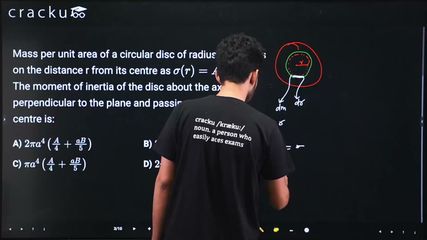
Mass per unit area of a circular disc of radius a depends on the distance r from its centre as $$\sigma(r) = A + Br$$. The moment of inertia of the disc about the axis, perpendicular to the plane and passing through its centre is:
The surface mass density of the disc is given as $$\sigma(r)=A+Br,$$ where $$r$$ is the distance of a point from the centre. We have to find the moment of inertia about the axis perpendicular to the plane of the disc and passing through its centre.
We consider a thin concentric ring of radius $$r$$ and radial thickness $$dr$$.
The elementary area of this ring is obtained from the geometry of a circle:
$$dA = 2\pi r\,dr.$$
Mass of this elementary ring is obtained by multiplying the surface density with the area:
$$dm = \sigma(r)\,dA = (A+Br)\, (2\pi r\,dr).$$
For a ring, every particle is at the same distance $$r$$ from the axis, so the elemental moment of inertia is
$$dI = r^{2}\,dm.$$
Substituting the expression for $$dm$$, we get
$$dI = r^{2}\,(A+Br)\,(2\pi r\,dr).$$
Simplifying the powers of $$r$$:
$$dI = 2\pi\,r^{3}(A+Br)\,dr.$$
To obtain the total moment of inertia, we integrate this expression from the centre (where $$r=0$$) to the rim (where $$r=a$$):
$$I = \int_{0}^{a} 2\pi\,r^{3}(A+Br)\,dr.$$
We separate the integral into two standard parts:
$$I = 2\pi\left[A\int_{0}^{a} r^{3}\,dr \;+\; B\int_{0}^{a} r^{4}\,dr\right].$$
Now we evaluate the individual integrals, using the power-rule formula $$\displaystyle\int r^{n}\,dr=\frac{r^{n+1}}{n+1}$$.
For the first integral:
$$\int_{0}^{a} r^{3}\,dr = \left[\frac{r^{4}}{4}\right]_{0}^{a} = \frac{a^{4}}{4}.$$
For the second integral:
$$\int_{0}^{a} r^{4}\,dr = \left[\frac{r^{5}}{5}\right]_{0}^{a} = \frac{a^{5}}{5}.$$
Substituting these results back, we obtain
$$I = 2\pi\left[A\left(\frac{a^{4}}{4}\right) + B\left(\frac{a^{5}}{5}\right)\right].$$
We now factor out $$a^{4}$$ from both terms:
$$I = 2\pi\,a^{4}\left(\frac{A}{4} + \frac{aB}{5}\right).$$
Thus, the moment of inertia of the disc is
$$I = 2\pi a^{4}\left(\frac{A}{4} + \frac{aB}{5}\right).$$
Hence, the correct answer is Option A.
Was this solution helpful?
Click on the Email ☝️ to Watch the Video Solution
Create a FREE account and get:
_1.webp)

Educational materials for JEE preparation

Ask our AI anything

AI can make mistakes. Please verify important information.
AI can make mistakes. Please verify important information.
